NIGERIA

WORLD NEWS

SCIENCE

THE QIBLA CHANGE

Posted on Tuesday, 31 March 2015 with Comments

Tuesday, 31 March 2015


Salamun Alaikum (Peace be upon you)


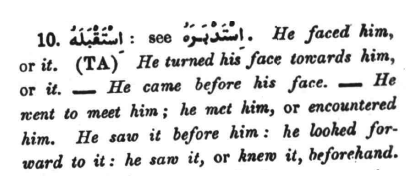
The Arabic word 'Qibla' is formed from its root word 'QAF-BA-LAM' and means to face or front something, to advance, to encounter or to confront face to face. It forms words such as 'istaqbalahu' which means that he faced him or it, that he turned his face towards him or it or indeed met him.


Other word derivates are also formed such as 'qubalatahu' which means opposite to, in a position so as to face him or it. Other words are also formed which imply a direction, point, place or something which is in front of another thing.


The Quran consistently uses the word 'Qibla' in the context of a direction of devotion or prayer (2:142, 2:143, 2:144, 2:145, 2:145, 2:145, 10:87)

010:087
"And We inspired Moses and his brother with this Message: "Provide houses for your people in Egypt, make your houses into places of worship / direction of prayer (Arabic: Qiblatan) and establish prayers: and give glad tidings to those who believe!" 
THE QIBLA CHANGE
In the main, four verses of the Quran (2:142-2:145) deal with the incident in question. Through an analysis of these verses God willing, an attempt will be made to ascertain how much information one can extract and infer with regards the event in question.
THE FIRST CHANGE
002:142
"The fools among the people will say: "What has turned them from the Qibla to which they were used to?" Say: To God belong both the east and West: He guides whom He will to a Way that is straight"


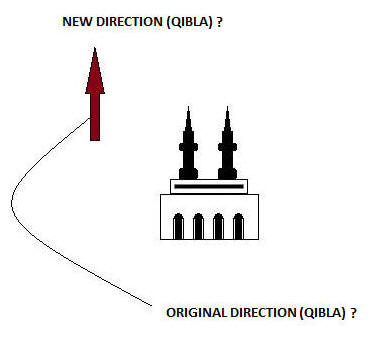
It is clear from the above verse that a change has already been made. It is also clear that some assertions had been made by a section of the community who clearly questioned the Qibla change. Therefore from the first verse, we note that ONE Qibla change had occurred and therefore TWO separate directions are involved. One direction from which the change occurred and a second direction to which the change was made.
What is not immediately obvious from the verse at this stage is (a) What the original direction was and (b) the location of the new direction.


INFERENCES:

The audience are clearly a section of the community described as 'foolish' (sufahau minal-nasi) and a very telling statement is captured which gives one a strong indication of the identity of the original 'Qibla'. "What has turned them from the Qibla which they were used to (allati kanu ayaha)?". The centre of devotion of the Prophet's community had always clearly been the Ka'ba which was also the Pagan sanctuary and a place of worship since the time of 'Jahliyya' (ignorance). Therefore, from the verse it is likely that a change had been made from the original sanctuary (the Ka'ba) which prompted the question from a section of the community.

This change must have indeed been momentous. A place of worship that had been utilised by generations as a centre of Pagan worship had now become challenged by a monotheistic preacher and his followers. The reason for the change is noted in the very next verse. This was to reveal those who were sincerely prepared to follow the teachings of the Prophet and to expose those that may not have truly believed or followed his message with sincerity. These individuals were possibly from those who were prepared for partial compromises such as retaining certain rituals and those beliefs that did not necessarily compromise their existing beliefs such as their particular direction of devotion and rejecting others.

002:143
"And thus We have made you a middle nation (of the middle way / balanced community) that you may be witnesses against mankind, and that the messenger may be a witness against you. And We appointed the Qibla which you formerly observed only that We might know him who follows the messenger, from him who turns on his heels. And indeed, this was a great (test) except for those whom God has guided aright. And it was not God's purpose that your faith should be in vain, for God is Full of Pity, Merciful toward mankind"

Albeit the location of the new direction is unclear from the verses, there are further inferences that can be drawn. Prophet Muhammad (pbuh) at this stage was clearly associating himself with Prophet Abraham (pbuh) in faith. The message that had now been revealed to him in Arabic speech was a confirmation and continuation of the guidance from the previous scriptures and united him in faith with those to whom the previous scriptures had been revealed (Jews and Christians). There is also some affiliation noted with the Holy Lands in verse 17:1 where a journey was made to the Holy Lands, an area which had clearly been blessed. It is very likely therefore, that the new 'Qibla' was consistent with those of the previous scriptures and pointed towards the Holy Lands given that the revelation united him in faith with the followers of those Prophets to whom inspiration had also been sent.

004.163 -64
"Indeed, We have sent you inspiration, as We sent it to Noah and the Prophets after him we sent inspiration to Abraham, Isma'il, Isaac, Jacob and the Tribes, to Jesus, Job, Jonah, Aaron, and Solomon, and to David We gave the Psalms. And messengers We have already mentioned to you and of others We have not and to Moses God spoke direct (speaking with him / (in) a conversation) (Arabic: takliman)" 

This view is further supported by the statement made by the section of the community that questioned this change (2:142). God responded by informing them that all directions belonged to Him and that in effect, He was Omnipresent and God of them all.

002:142 (Part)
"...Say: To God belong both the east and West: He guides whom He will to a Way that is straight"
THE SECOND CHANGE
002.144 -45
"Indeed, We see the turning of your face (for guidance) to the heavens. So We shall surely turn you to a direction of devotion / prayer (Arabic: Qiblatan) that you will be pleased with. So turn your face in the direction of the sacred Mosque and wherever ye are, turn your faces in that direction. And indeed, the people of the Book know well that it is the truth from their Lord and God is not unmindful of what they do.  Even if you were to bring to the people of the Book all the Signs (together), they would not follow your direction of devotion / prayer (Arabic: Qibla); nor are you going to follow their Qibla; nor indeed will they follow each other's Qibla. If you after the knowledge has reached you, were you to follow their (vain) desires, indeed, you (would) then (be) surely among the wrongdoers"

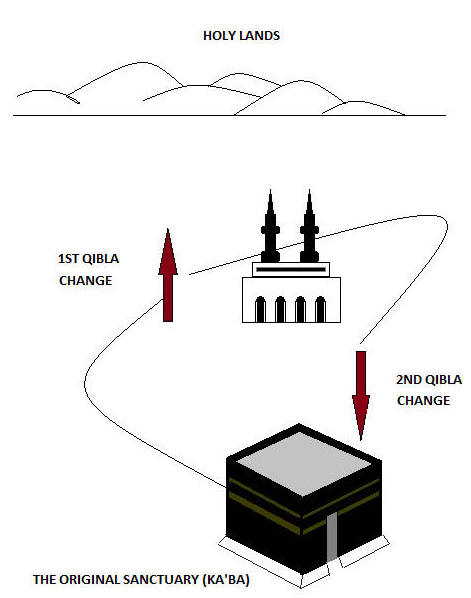
A second change is noted in the above verse and confirmed as one towards the Sacred Mosque (the Ka'ba). It is also clear that this location was a separate Qibla from the followers of the previous scriptures. The separation of the two Qibla's is now clearly emphasised. It's emphatic tone supports the earlier suggestion that the first Qibla change was indeed made towards a direction of the Holy Lands and this second change amounted to a change from the Holy Lands back to the original sanctuary at Makkah (i.e. the Ka'ba). It is also quite significant to note the expression "nor are you going to follow their Qibla (wama anta bitabi'in qiblatahum)" which also supports the suggestion that the Prophet had indeed once followed their Qibla.

From the verse it is also noted that the Prophet was clearly subject to some anguish. The exact reason for the anguish is not elaborated but this could be a part of his personal struggle, one resulting from the pressures of his community or a mixture of both. However the nature of the anguish seems to be associated with the direction of prayer that was being currently followed. God's response came to alleviate this distress '...So We shall surely turn you to a direction of devotion / prayer (Arabic: Qiblatan) that you will be pleased with'.

Given the Prophet's background and his association with the Ka'aba, it is not surprising to note that the direction was reinstated back to the Sacred Mosque (Masjid Al-Haram) which throughout the Quran is only a reference to the Makkan sanctuary. The People of the Book clearly would not have followed this Qibla and the status quo now constituted of two different directions of prayer. There would have remained one direction for the followers of the previous scriptures and a second for the followers of the final message (i.e. The Quran). God could never be restricted to any one direction (all directions / everything belonging to him) therefore the linkage was now to remain by virtue of faith as opposed to direction.


FINAL THOUGHTS


Two Qibla changes are noted from the Quranic verses. It has been suggested in the above article that the original Qibla was indeed the Makkan sanctuary (the Ka'ba). This was later changed for the reasons cited by verse 2:143 to possibly a location in the Holy Lands such as Jerusalem which was the centre of devotion for the people of the previous scriptures. The second Qibla change was a reversion back to the Ka'ba from the Holy Lands.


REFERENCES
[1] LANE. E.W, Edward Lanes Lexicon, Williams and Norgate 1863; Librairie du Liban Beirut-Lebanon 1968, Volume 8, Supplement, Page 2983

[2] Ibid., Page 2984

READ MORE

Debunking the Extremist Myth That Islam is Anti-Jewish

Posted on with Comments

New bus ads in DC say the Qu'ran promotes Jew-hatred. It's a meritless, dangerous accusation.'

The fiasco continues.

Islamophobes are fabricating the myth that Islam promotes Jew-hatred by taking out ads on D.C. buses. Take a look at the ad, linked above—does anyone else find it insane that these ignorant people are spending money promoting pictures of Adolf Hitler?

Now, certainly some Muslims are anti-Jewish, as are some Christians, agnostics, atheists—you get the idea. However, nothing in the Qur’an or in Prophet Muhammad’s example supports the myth of “Islamic Jew hatred.”

As I detail in my upcoming book, EXTREMIST, an objective study of Islam demonstrates that the myth of Islamic Jew hatred crumbles like a house of cards.
So let’s dig in.
Those who proclaim Islamic Jew-hatred deliberately misrepresent the Qur’an 7:167—among several more verses. My analysis of 7:167 below—which is equally applicable to any allegedly “anti-Jew” verse—demonstrates without question that nothing here is “anti-Jewish.” But to remain objective, I reference Dr. Philip Jenkins—a prolific non-Muslim academic—who, on the question of Islamic Jew-hatred writes in his book Laying Down the Sword:
“In order to make such texts look vicious, anti-Islamic critics systematically exaggerate the Jewish element in the passage… The Qur’an offers nothing vaguely as explicit as the New Testament passages in which Jesus himself, who is for Christians the incarnation of the Divine, speaks so furiously against “the Jews.” It is the Jesus of the New Testament who calls his enemies the children not of Abraham but of the Devil, the Father of Lies. [But Jesus] was not condemning all Jews in any racial sense, but was rather attacking rival factions and leaders in his day. And that is the model we find in the Qur’an. In reality, the Qur’an has nothing that need be taken as a condemnation of Jews, or of any ethnic group.”
The Qur’an instead condemns unjust behavior while lauding just behavior—regardless of the person or people committing the act. Simply reading 7:166 and 7:167 together illustrates this point:
“And when [the Jews] forgot all that with which they had been admonished, We saved those who forbade evil, and We seized the transgressors with a severe punishment because they were rebellious. And when they insolently rebelled against that which they had been forbidden, We said to them, “Be ye apes, despised!”
Here the Qur’an speaks of Jews and the Sabbath. God “seized the transgressors” because “they were rebellious.” Just as important, God “saved those [Jews] who forbade evil.” The distinction is not Jew or non-Jew; the distinction is Jews who observed the Sabbath verses Jews who profaned the Sabbath. And for perspective, while the Qur’an metaphorically refers to as “apes” only those Jews who profaned the Sabbath, the biblical condemnation of Jews who profaned the Sabbath in Exodus 31:15 is quite violent: “Whoever does any work on the Sabbath day must be put to death.”
Far from “Jew hatred,” the Qur’an 2:63 repeatedly declares that the Jews shall attain eternal paradise. The Qur’an mentions Prophet Moses by name more than any other prophet—over 150 times— and Islam recognizes the Divine origin of the Torah and the Psalms of David. Prophet Muhammad’s benevolent treatment of Jews attracted their love for him. Safwaan bin Assal relates, “some people among the Jews kissed the hands and feet of the Prophetsa.” It is impossible to consider that a man could garner such love from his citizens with force or violence. Following this example, throughout Islamic history the Jews flourished under Muslim rule in parts of North Africa, Jerusalem, Persia, and Spain.
As Jenkins notes, it is the Gospel of John that incites fear of the dangers Jews posed to Christ, names Jews as dogs, swine, and snakes in Matthew, and declares the Jews’ father is the devil again in John. Martin Luther thus wrote, “What then shall we Christians do with this damned, rejected race of Jews? …their synagogues should be set on fire…their homes should likewise be broken down and destroyed…rabbis must be forbidden under threat of death to teach any more… [let us] be free of this insufferable devilish burden—the Jews. Pope Clement VIII added, “All the world suffers from the usury of the Jews, their monopolies and deceit.”
Thousands of Jews were murdered during the Crusades, the Spanish Inquisition, and at various times in Europe and Russia. The word ghetto owes its origin to the slums of Venice where Jews lived. Father Charles Coughlin commanded a weekly radio audience of more than thirty million Americans in the 1930s and openly supported anti-Semitism, Adolf Hitler, and Benito Mussolini. And lest we forget, Hitler identified as Christian.
Thus, blindly blaming Islam—which is responsible for none of the above atrocities—ignores that anti-Semitism is a worldwide epidemic. The Anti-Defamation League, in its 2012 report on anti-Semitism in ten European countries concluded, “As with previous surveys, data from this latest 2012 European tracking poll indicates that significant percentages of European respondents continue to believe in some of the most pernicious anti-Semitic stereotypes.” A 2011 ADL poll found that about 15 percent of the US population—forty-five million Americans—“fall into the most anti-Semitic co-hort.”
This allegation of Islamic Jew-hatred is dangerous because it is meritless, creates an irrational fear of Islam and of Muslims, and ignores the factually proven growing anti-Semitism in Europe and America. Per Islamic teaching, Prophet Muhammad treated Jews as equals and with compassion. So enough of these ridiculous bus ads—find something productive to spend your money on. Let’s stop blindly blaming Islam for anti-Semitism and instead work together to root out anti-Semitism wherever it exists.

READ MORE

NO SECTS IN ISLAM - WE ARE ONLY MUSLIMS (THOSE THAT SUBMIT)

Posted on with Comments
Muslims today have regrettably divided and subdivided themselves into numerous sects each one labeling themselves by diverse names such as Sunni (e.g. Hanafi, Hanbali, Maliki, Shafi, Barelvi, Wahabi, Deobandi) or Shia (e.g. Twelver, Ismaili, Jafri, Zaidiyya, Khwarij), or Sufi (e.g. Chishti, Naqshbandi, Mawlawi, Qariyyah) and many others.

The Quran strongly forbids divisions of any sort or to associate with those that break away into sects.

006.159
"Indeed, those who divide their religion and break up into sects, you have no part with them in the least: their affair is with God: He will in the end tell them the truth of all that they used to do"

THE ONLY ACCEPTABLE LABEL - I am of those that submit to the one God (i.e. Muslim)
041:033
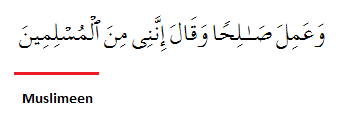
Who is better in speech than one who calls (men) to God, works righteousness, and says, "I am of those who submit i.e. Muslims (Arabic: Muslimeen)?"


The word 'Muslim' is not only used to describe the followers of Prophet Muhammad (pbuh). This word has been used in the Quran to describe all those who submit and surrender to the will of the One Lord who created the heavens and the earth and is the Master of the Day of Judgment.


  • Pharaoh's magicians submit to God after witnessing Prophet Moses's (pbuh) sign from his Lord and are ready to die as those who submit to God (Muslimeen) [7:126]
  • Prophet Noah (pbuh) asks for no reward from his people. He only submits to God (Muslimeen) [10:72]
  • Prophet Moses (pbuh) speaks to his people to put their trust in God if they submit to Him (Muslimeen) [10:84]
  • Prophet Solomon's (pbuh) letter to Sheba (Saba) requesting her in the name of the Lord to abandon her blasphemy and to surrender herself to God (Muslimeen) [27:31]
  • Prophet Solomon (pbuh) acknowledges his own surrender to his Lord (Muslimeen) [27:42]
  • Prophet Muhammad (pbuh) is instructed to say that he has been commanded to be of those that submit to God (Muslimeen) [27:91]
  • Those who have persevered with the truth from the People of the Book and when it is recited to them, acknowledge that they have already been from those that have submitted to God (Muslimeen) [28:53]
  • All but one house belonging to Lot (pbuh) (from his community) had submitted to God (Muslimeen) [51:36]
  • Disciples of Prophet Jesus (pbuh) confirm that they submit to God (Muslimoon) [3:52]
  • Prophet Abraham (pbuh) was one who submitted to His Lord (Musliman) [3:67]
  • Prophet Joseph (pbuh) prays to his Lord to die as one who submits to his Lord (Musliman) [12:101]
  • Prophet Jacob's (pbuh) children at the point of their father's death profess that they submit to God (Muslimoon) [2:133]

 
DO NOT BE DIVIDED
003:103
"And hold firmly, all together, by the rope which God (stretches out for you), and be not divided among yourselves; and remember with gratitude God's favour on you; for you were enemies and He joined your hearts in love, so that by His Grace, you became brothers; and you were on the brink of the pit of Fire, and He saved you from it. Thus does God make His verses clear to you so that you may be guided"


Please see related articles:


REFERENCES

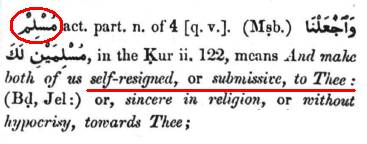
[1] LANE. E.W, Edward Lanes Lexicon, Williams and Norgate 1863; Librairie du Liban Beirut-Lebanon 1968, Volume 4, Page 1416
Highlights marked in red on the lexicon excerpt are my own insertions. They have no bearing on the original text other than they emphasise relevance to the topic at hand. These are merely illustrations and have solely been utilised for educational and explanatory purposes.

READ MORE

EXODUS OF PROPHET MOSES'S (pbuh) PEOPLE

Posted on Sunday, 29 March 2015 with Comments

Sunday, 29 March 2015

My intention to share this piece with the reader, is to highlight how popular understandings are at times accepted, without much consideration or thought to determine their veracity.

This article also highlights how dependant Quranic interpretations can be at times on classical interpretations which indiscriminately rely on Biblical narratives. This is despite the fact, that there may exist an irreconcilable variance between the Quranic and Biblical record of the same event. In this case, the Quran, in the voice of God, would be correcting a Biblical depiction whilst still guarding the overall integrity of the Biblical narrative.

Rather than being harmonised, they should be accepted as being different in what they attempt to narrate.

Popular words are often mistranslated to support these 'harmonisations', which can render Quranic passages incomprehensible and often to 'appear’ as contradictory.

The Biblical narrative is not the focal concern in this article, though, it will be discussed briefly with a view to set a context to highlight the Quranic differences. It is also not the intention to 'criticise' the Biblical narratives in any way (I completely oppose this approach). Rather, it is to highlight areas where I feel in my mind, there are difficulties of reconciliation within the Biblical narratives and in specific contexts only.

The Biblical narrative supports the understanding, that approximately 1.5 million people including men, women, young, old, sick and handicapped (as a cross section of any society), with their possessions including flocks and herds, were allowed to leave Egypt by Pharaoh. This was after the last sign by God came into effect.

The last sign (10th portent) was the death of every first born Egyptian son, which included Pharaoh's own son. However, once allowing the Israelites to leave, Pharaoh then had a change of heart (Exodus 14:5 Hebrew: 'haphak' (overturn / change) 'lawbab' (heart / mind / inner man / understanding) and gave pursuit with his army.

Such a mass Exodus in the way it has been described in the Biblical record does raise a few concerns.

Difficulties include reconciling the mass Exodus with logistics, extant archaeological proof, (which fails to show conclusive signs of settlements anywhere of such a kind during mass migration, especially when the Israelites remained in the desert for over 40 years) and also the internal rationalisation of certain of the Biblical narratives. 

However I also appreciate, that absence of proof in terms of extant convincing archaeological evidence, is not tantamount to proof of absence of the Exodus.


THE BIBLICAL PERSPECTIVE

According to the Bible, in particular Exodus 12:37, we read the following:

Exodus 12:37
“And the children of Israel journeyed from Rameses to Succoth, about six hundred thousand on foot that were MEN (Hebrew: 'gheh-ber'), besides children    [1]

Note that the Hebrew word 'gheh-ber' is used, which implies a man of strength, or a warrior (emphasising strength or an ability to fight). The first question arises. Are these regular men, or fighting men which excludes non-warriors? (in which case the total number of men would be much higher).

(1)    According to this passage, 600,000 men who were descendants of Jacob left Egypt. In addition to the 600,000 men, there must have been women and many children that went with them.  This is not including the mixed multitude of people that also left with them (Exodus 12:38), or the flocks and herds that they brought with them.

Exodus 12:38
“And a mixed multitude (Hebrew: 'Ereb' - mixture / mixed people or company 'rab' - many) went up also with them; and flocks, and herds, even very much cattle (Hebrew: 'meh-ode' 'kabed' - exceeding, heavy great, in abundance)    [2]

The above passages make it clear that a very large number of Israelites gathered to leave.  Another problem that is quite puzzling, (and has been for many modern scholars) is the number of men conscripted into Israel's army. Numbers 1:44 relates this as 603,550 and Numbers 26:51 relates this as 601,730. Quite apart from the discrepancy,  these large numbers of men mustered for warfare, would demand of a total population in excess of 2 million. This seems exceedingly large for wanderings in the desert and in comparison to the inhabitants of Canaan which Numbers 3:43 states as 22,273.

Also In Exodus 12:41, we read the following:


"And it came to pass at the end of the four hundred and thirty years, even the self same day it came to pass, that all the hosts (Hebrew: 'Tsebah' one that goes forth / warfare / army / war /  hosts) of the LORD went out from the land of Egypt"   [3]


In contrast, the size of Pharaoh's army was relatively small, only amounting to 600 chariots (Exodus 14:7). However, the Hebrew word 'baw-khar' (chosen / elected) in Exodus 14:7 does indicate that the 600 chariots were chosen or elected chariots. Furthermore, we are told these were possibly excluded from the other chariots which were gathered with them (Hebrew: kol rekeb - whole / all chariots of Egypt (Hebrew: Mits-rah'-yim). The threat posed by 600 chariots plus all other chariots (number being unknown from Exodus 14:7), in relation to an excess of 600,000 warriors of the Israelites is worth considering. 

(2)    One must also consider the simple logistics to supply food, water and to move such a huge Exodus across the harsh plains of the Sinai desert. This would require tonnes of food, wood for fuel and millions of gallons of water each day to supply such a group.

(3)    Another problem is the location of lavatory facilities. Deuteronomy 23:12,13 states:

Deuteronomy 23:12-13
“You shall have a place outside the camp (Hebrew: 'Chuts' (outside) 'Makh-an-eh' (encampment / camp) and you shall go out to it; and you shall have a trowel with your tools; and when you sit down outside, you shall dig a hole with it, and turn back and cover up your excrement (Hebrew: 'Tsa-ah' filth / excrement / faeces)   [4]

If this directive was applicable and the large number of Israelites during the Exodus is to be accepted, then the size of the camp would no doubt be possibly many miles wide. One located in the centre of the camp, would potentially need to walk many miles to exit the camp.

If 1.5 million people (very conservative estimate) inhabited the desert plains for 40 years, one would expect to find some traces of settlement in the archaeological record. Nothing which indicates such a mass migration has ever been found to my knowledge. (Again, absence of proof does not amount to proof of absence which I fully accept).


THE QURAN’S PERSPECTIVE

The Quran's perspective is quite different. Firstly, the Quran does not indicate such a mass migration. It also does not agree with the position that Pharaoh ever gave leave for the Children of Israel to exit Egypt. The Quran is clear that Prophet Moses (pbuh) was informed by God to leave in the night and was told that he would be pursued and not to fear (20:77; 26:52). The context of the narrative does not suggest a mass gathering and movement in the daytime. This will be discussed below.

(1)    PHARAOH’S PEOPLE AND COUNCIL FEARED EXPULSION OF THEIR OWN PEOPLE FROM EGYPT

The Quran narrative makes it clear on many occasions that the people of Pharaoh feared that they would be expelled from their own lands by the Israelites. In the Quranic narratives dealing with this context, the word ‘ard’ (land) has been used to signify the land of Misr (Egypt).

007:110 - The Chiefs of Pharaoh claim that Prophet Moses’s (pbuh) plans are to get them out of their land (i.e. Egypt).
007:123 - Pharaoh claims that Prophet Moses’s (pbuh) plan is to drive his people out of the land.
020:057 - “He said: "Have you come to drive us out of our land with your magic, O Moses?”.
020:063 - “They said: "These two are certainly (expert) magicians: their object is to drive you out from your land with their magic, and to do away with your most cherished institutions”.

The above verses clearly state that Pharaoh and his people feared expulsion from their lands. These lands are clearly a reference to Egypt.

(2)    NOT ALL OF THE ISRAELITES LEFT EGYPT

The Quran clearly stipulates that the band that left with Prophet Moses (pbuh) were a few (in relation to the remainder of the Israelite population).

026.052-56 
By inspiration we told Moses: "Travel by night with my servants; for surely ye shall be pursued."  Then Pharaoh sent heralds to (all) the cities, (saying): "These (Israelites) are but a small band (Arabic - lashir-dhimatun qaliluna), "And they are raging furiously against us; "But we are a multitude amply fore-warned." 

It is a far stretch of the imagination given the above context that Prophet Moses (pbuh) had the capacity to suddenly muster over 1.5 million people so quickly in the night including men, women, children and the elderly. It is more likely, that a group of the Israelites left with Moses (pbuh) (could be 100’s, possibly 1000's) as they were quickly summoned to in the depths of the night.

Also the reference to the ‘small band’ that Pharaoh’s army intended to pursue cannot be a reference to the whole Israelite population.

(3)    GOD’S PLAN CLEARLY STATED

God’s plan was clearly to cause the oppressed Children of Israel to inherit the dwellings of Pharaoh and some of his displaced people. For others that travelled with Prophet Moses, (pbuh) the decree was to inherit part of the ‘Holy Lands’ (Promised Land) towards Canaan.

026.057 
“So We expelled them from gardens, springs”

026.058
“Treasures, and every kind of honourable position”

026.059
“Thus it was, but We made the Children of Israel inheritors of such things”

Commentators create all sorts of confusion attempting to reconcile 26:59 with the Promised / Holy Land which the Children of Israel did not acquire until nearly half a century later. The context clearly refers to the dwellings, gardens and springs, left behind by Pharaoh and his people in Egypt when they gave chase to the particular group (band) that left with Prophet Moses. (pbuh)

Any other interpretation to support this to be a reference to the Holy Lands in the future, is not warranted by context and is an extremely untenable interpretation. It is clear from the Quranic narrative that those of the Israelites that were left behind (the remainder) inherited these vacant estates.

This is also proved by the following verses:

044.023-28 
“Then (his Lord commanded): Take away My slaves by night. Lo! ye will be followed,  And leave the sea behind at rest, for lo! they are a drowned host.  How many were the gardens and the water springs that they left behind,  And the corn lands and the goodly sites  And wealth (and conveniences of life), wherein they had taken such delight! Even so (it was), and We made it an inheritance for other folk (Arabic: Kawman Akhireen)

The ‘other’ folk (Arabic: Kawman Akhireen) cannot be a reference to the ones that were pursued given the context of the narrative, but rather, a reference to those that were left behind and inherited what the Egyptians had left. This is clearly a reference to the inheritors mentioned in 26:59.

Again we see this confirmed in the following passage:

028.005-6
“And We wished to be Gracious to those who were being depressed in the land, to make them leaders (in Faith) and make them heirs, To establish a firm place for them in the land, and to show Pharaoh, Haman, and their hosts, at their hands, the very things against which they were taking precautions”


(4)    THE PERSECUTED ISRAELITES INHERITED THE EASTERN AND WESTERN LANDS

The persecuted Israelites inherited some of the Eastern lands of Egypt and those that left with Prophet Moses, (pbuh) inherited the Western parts of the land, which God informs were blessed (allati barakna fiha).

007:137
And We made the people who were deemed weak to inherit the Eastern lands (Arabic: ardi) and the Western of it (Arabic: wamagharibaha) which We had blessed (Arabic – Barakna Fiha); and the good word of your Lord was fulfilled in the children of Israel because they bore up (sufferings) patiently; and We destroyed what Pharaoh and his people used to make and what they built”

Please note again, the use of the Arabic word 'ardi' which has been used in this context to denote 'Egypt'. Therefore, the Eastern parts of Egypt are the locales which are referred to as being inherited. The Arabic word 'wamagharibaha' is a reference to the 'Western parts of it', the 'it' referring to the locales which were blessed. i.e. the Holy Lands (barakna fiha) 

The word ‘barakna’ along with ‘fiha’ or ‘hawlahu’ in the Quran has always been used as a reference reserved for localities of the Holy Lands.

Terms used in the Quran.

(i)    Barakna hawlahu

 017.001 - Masjid Aqsa

(ii)  Barakna fiha

007.137 - Blessed lands for the Children of Israel
021.071 - Prophets Abraham and Lot (pbut) delivered to the blessed lands
021.081 - Wind flowed for Prophet Solomon (pbuh) on the blessed lands
034.018 - Saba and cities in-between


(5)    PROPHET MOSES (pbuh) AND HIS PEOPLE CAME TO THE HOLY LAND NOT EGYPT

The flight of those people that left with Prophet Moses (pbuh) saw them to a land described as 'Holy'. The word 'Holy' has never been used to describe the land of Egypt (Misr). Rather, the term 'land' (ard) is used to describe it. Therefore, the ‘Holy land’ can only be a reference to the blessed plains of the localities of the promised lands in Canaan.

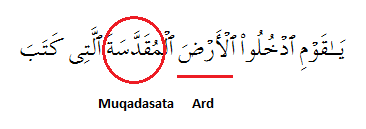
005:021
“O my people! Enter the Holy (Arabic: Muqadasata) Land (Arabic: Ard) which God has assigned to you, and turn not back, for then will ye be overthrown, to your own ruin." 


The root of the word 'Holy' is QAF-DAL-SIN as also seen in the word 'Holy Spirit' (Arabic: Ruh-e-Qudus - 16:102)


(6)    A REBUKE TO RETURN BACK TO EGYPT

002:061
“And remember ye said: "O Moses! we cannot endure one kind of food (always); so beseech thy Lord for us to produce for us of what the earth grows, -its pot-herbs, and cucumbers, Its garlic, lentils, and onions." He said: "Will ye exchange the better for the worse? Go ye down to Misran (Egypt) and ye shall find what ye want!" They were covered with humiliation and misery; they drew on themselves the wrath of God. This because they went on rejecting the Signs of God and slaying His Messengers without just cause. This because they rebelled and went on transgressing”

Very few Muslim English commentators translate ‘Misr’ in this verse as Egypt, even though, ‘Misr’ has only been used to signify Egypt in the Quran.

010:087
We inspired Moses and his brother with this Message: "Provide dwellings for your people in Egypt (Arabic: Misr), make your dwellings into places of worship, and establish regular prayers: and give glad tidings to those who believe!" 

012:021
The man in Egypt (Arabic: Misr) who bought him, said to his wife: "Make his stay (among us) honourable: maybe he will bring us much good, or we shall adopt him as a son." Thus did We establish Joseph in the land, that We might teach him the interpretation of stories (and events). And God hath full power and control over His affairs; but most among mankind know it not.

012:099
Then when they entered the presence of Joseph, he provided a home for his parents with himself, and said: "Enter ye Egypt (Arabic: Misr) (all) in safety if it please God." 

043:051
And Pharaoh proclaimed among his people, saying: "O my people! Does not the dominion of Egypt (Arabic: Misr) belong to me, (witness) these streams flowing underneath my (palace)? What! see ye not then? 

It is clear that given the requests of cucumbers, lentils and onions that they were not going to find this in the middle of the desert. This was something the Children of Israel were familiar with, hence demanded it as a reference to what they once had.

Prophet Moses’s (pbuh) response was apt in enquiring as to why they would want to exchange what is better for them, with something meaner. This response of Prophet Moses (pbuh) does not only have literal significance - The Manna and the Quails from heaven were arguably better food for them , but also spiritual significance. The Promised Land where they would get all these items (and possibly more) was far better given their perseverance in the sight of their Lord.  So the rebuke was for them to go back to Egypt if they did not want to continue with Prophet Moses. (pbuh)

Egypt is clearly Misr according to the Quran and not a random town, or city, as is commonly mistranslated by English commentators.


FINAL THOUGHTS


From the above discussions, it seems fairly evident that God wanted those that were oppressed, to inherit some of the dwellings left by Pharaoh in the Eastern parts of Egypt, by those that did not take flight with Prophet Moses. (pbuh) Those that did, were to inherit the Western parts of the lands that were blessed.


Further points to note:

  • Manna and Quails - Did they really have access to all their flocks and herds which would provide them with meat, milk, eggs and other types of foods if there was a requirement for them to receive Manna and the Quails from heaven? Clearly, the Israelites mention in 2:61, that they were tired of eating one type of food. This indicates that they did not have access to their flocks and herds.
  • Did they ever leave with such flocks as the Biblical narrative suggest en masse, or was this a migration of a small group from the Children of Israel who left in the night with Prophet Moses (pbuh) as confirmed above?
  • Finally, the Quran only mentions 9 signs and does not support the tenth Biblical sign, which resulted in the death of the first born.

THE PLAGUES

017.101
"To Moses We did give nine clear signs: As the Children of Israel: when he came to them, Pharaoh said to him: "O Moses! I consider thee, indeed, to have been worked upon by sorcery!"

They are all narrated in Surah Araf (Chapter 7)

(1) Staff / Rod (7.107)
(2) Radiant Hand (7.108)
(3) Years of Drought (Arabic - bil sinina)
(4) Shortage of fruit (Arabic - Wanaqsin mina l-thamarati) (7.130)
(5) Flood / Deluge (Arabic: Tufana) (7.133)
(6) Locust (Arabic: Jarada) (7.133)
(7) Lice (Arabic: Qumala) (7.133)
(8) Frogs (Arabic: Dafadia) (7.133)
(9) Water turning to Blood (Arabic: Dama) (7.133)


Related Article:

REFERENCES 

[1]   The Bible - King James Version.
Highlights marked in black text and in bold are my own insertions. This also includes the Hebrew elucidation text. These insertions have no bearing on the original text of the King James Version, other than they emphasise relevance to the topic at hand. These are merely illustrations and have solely been utilised for educational and explanatory purposes.
[2]   Ibid.
[3]   Ibid.
[4]   The Bible - English Standard Version (c 2001)
Highlights marked in black text and in bold are my own insertions. This also includes the Hebrew elucidation text. These insertions have no bearing on the original text of the King James Version, other than they emphasise relevance to the topic at hand. These are merely illustrations and have solely been utilised for educational and explanatory purposes.
READ MORE

Latest

Blog Archive

HIT ME

Join over 500 Followers