There has been much talk about the Muslim Brotherhood's strategic mistake of nominating a presidential candidate and dominating the scene of the revolution in Egypt.
This puts us in a sticky situation when addressing the Brotherhood's reformative approach, the phases of which are set according to the messages of the Brotherhood founder Hassan Al-Banna, which dictates that reform must be gradual, beginning with the formation of the individual, then the family, followed by the society that comprehensively embraces Islamic thought. According to the Brotherhood's vision, the government should help apply Islam, but would it have allowed for participation in the Egyptian Revolution that lasted 18 days? If it had allowed participation in order to resist injustice and tyranny and to promote the rights of humans to freedom and dignity, was it right to dominate the scene? Or was it a fatal strategic mistake? Or was it imposed on them, like a "forcing move" on a chessboard? The more important question is: What impact has the Arab Spring, and the subsequent coups and counter-revolutions, had on political Islam movements, especially the mother movement in Egypt? Has it weakened the movement?
First of all, I must state the fact that while discussing any decision made by any institution, one must take into consideration the conditions under which the decision was made, the factors surrounding the decision-maker, and the ambiguities that are revealed over time. I believe, and I may be mistaken, that the Brotherhood's participation in the January Revolution was a mistake because it overstepped a number of phases set out by their approaches and they rushed to reap the fruit of what they sowed, in light of a society too busy demanding life's necessities to demand their freedom and make sacrifices for the sake of it. This is especially true because the youth, who called for the January 25th revolution, were not dreaming of overthrowing the regime, let alone demanding it, and all of the calls and hopes of freedom and human dignity were violated when Khaled Said and Sayed Bilal were killed under police torture. Once the Brotherhood youth took to the streets to officially participate in the demonstrations on 28 January, this gave momentum to the revolution and raised the ceiling of expectations, especially after a number of individuals were martyred on that day. Thus, the sole demand became overthrowing the regime. This was used by the military council to get rid of the inheritance of power system, which was a source of concern for the military leaders.
If the Brotherhood's participation in the revolution was a voluntary move on the chessboard, then nominating a presidential candidate was a "forcing move" made at a time when the dissolution of the parliament was looming on the horizon and at a time when the military was committed to the Attorney General, who was known for protecting those who killed revolutionaries and fabricating charges against those opposed to the Mubarak regime. This also occurred at a time when several independent individuals refused to ally with the Brotherhood and face the "Deep State" candidates who are backed by the ruling military junta. This had foreshadowed the events following the July 2013 coup, which included exclusion and legal and judicial revenge against all those who participated in this revolution, albeit in a crooked manner.
While we deduce the impact of the counter-revolution and the coup against legitimacy and the subsequent oppression and persecution of political Islam movements, at the heart of which is the Muslim Brotherhood in Egypt, we find that the movement is suffering an unprecedented state of abuse, murder, persecution and exclusion. In addition to this, all limits are being surpassed when it comes to dealing with women, as they are being arrested and tortured. In addition to this, the number of death sentences issued has exceeded the number of those issued in the 1950's by Gamal Abdel Nasser. However, the change in the group's approach to dealing with and resisting the 2013 coup radically differed from the group's surrender to the coup in 1954, and this greatly contributed to the successes achieved with regards to the resistance on the Egyptian street and by the group, which the coup leader vowed to eliminate and tried with all his might to do.
According to Arnold Toynbee's theory on the emergence of civilisations, successful responses to major challenges generate renaissance and civilisation. The Muslim Brotherhood's refusal to surrender to the military and accept the crumbs of freedom it offers may lead to the birth of a new renaissance in Egypt. With regards to positive impact and influence on Islamic movements, we can briefly address this by developing the Brotherhood's approach from a reformative approach to a revolutionary and resistance approach. The approach of some Salafist trends that participated in the National Alliance Supporting Legitimacy can also be developed by practicing the revolutionary political work it had refused in the past. The young generation must lead the next phase after the enforced disappearance of the Brotherhood's front line and middle level leaders and officials, either due to detention, persecution, or murder.
The role of women in the Islamic movement will also grow, and they will make greater sacrifices and will be models of revolutionary jihadists, such as Sana Abdul Jawad and the girls from Alexandria and Al-Azhar who were told by a judge that they would be the mothers of Egypt's future leaders.
Yes, the blows delivered to the political Islam movements were harsh and painful, but they have produced a strong generation capable of a new renaissance in society.
Equality is emphasised in the Qur’an repeatedly through referencing the origin and nature of human creation. The Qur’an describes humans as biologically different, but ontologically and ethically-morally the same as both women and men originate from a single Self. They thus have been given the same natures. The Qur’an instructs believers to
Reverence Your [Rabb], Who created you From a singlenafs[“Person”] Created, of like nature, [its]zawāj[mate] and from them twain Scattered (like seeds) Countless men and women; — Reverence God, through Whom Ye demand your mutual (rights).
The Qur’an (4:1; in Ali, 178)
Nafs(feminine plural) can be said to refer to Self, or Person, not soul, as it was interpreted by early Muslim scholars, who, under Greek influences, invented a typology of spirit, soul, and body, in which the spirit occupied the highest place and was associated with man, and the soul occupied a lower rank and was associated with woman. This typology can and has been used to read sexual hierarchy and inequality into ayats. However, the Qur’an itself does not promote mind-body or body-soul dualisms, nor does it promote sexual differentiation. Words likenafsandzawajspeak about the essential similarity of men and women and does not treat the male as normative.
Throughout the Qur’an, in different contexts, this same image of men and women coming from a single Self is repeated and emphasised.
– “It is [God] Who hath Produced you From a single person” (6:98; in Ali, 317) – “It is [God] Who created You from a single person, And made [its] mate of like nature, in order That he might dwell with her (In love)” (7:189; in Ali, 398) – “God has made for you Mates (and Companions) of your own nature” (16:72; in Ali, 675) – “And among [God’s] Signs Is this; that [God] created for You mates from among Yourselves, that ye may Dwell in tranquility with them” (30:21′ in Ali, 1056) – “We created You from a single (pair) Of a male and a female, And madeyou into Nations and tribes, that Ye may know one another” (49:13; in Ali,1047) – of [ihsān] [God] made Two sexes, male and female” (75:39; in Ali, 1653)
The reason given from the Qur’an for the ontological equality and similarity of the two sexes is that they were meant to coexist within a framework of mutual love and recognition. There is no hierarchy. No superiority accorded to one sex over the other. These ayats (lines), by according equal essential substance to both sexes, are clear in establishing that men and women are equal. So why does reality point to an unequal treatment of women? Something which has also been seemingly justified through the religion?
The Qur’an has no ayats that claim that men and women were created from different substances, or that they have opposing attributes, or that woman was created from man or that woman was created after man — claims that have been used to theologically justify male superiority.
Although many muslims read Adam’s creation as the principle of male superiority, the term Adam is a Hebrew and not Arabic word that means ‘ of the soil (from ‘adamah’). The term Adam functions generally as a collective noun referring to the human species rather than the male human being. In the Qur’an, “the term ‘Adam’ refers, in 21 cases out of 25, to humanity. It is both a universal and specific term and its generic, universal terms is what the Qur’an uses to define human creation.
There is also the famed Fall from heaven that has also been used to theologically justify the inferiority of women, since Eve (Hawa) caused the ejection of humanity from Paradise. However, Islam does not propagate the idea of The Fall as something that tears the divinity from the human experience, instead, the expulsion of the pair from Paradise opens up the possibility for humanity to receive immeasurably God’s Mercy and acquire moral salvation through our own behaviour and morality (we would not have truly work to deserve Paradise if we were already there!).
Even though the Qur’an expulsion narrative does not suggest the loss of Divine Grace or the woman’s role in bringing it about, Muslim exegetes have borrowed wholesale from biblical accounts to assert Eve (Hawa)’s role in The Fall and her creation from Adam’s rib. There is also the popular belief that menstruation and childbirth are punishments for Eve (Hawa)’s sin. Such beliefs thus serve to justify women’s sinful, weak, inferior natures even though they aren’t actually Qur’anic or Islamic. And even if one were to borrow the biblical accounts, these too were distorted. The Old Testament does not preach the idea of original sin or of the sexual fall. The early Hebrews emphasized that all humans were created in God’s image. The claim that Eve(Hawa) was created from Adam’s rib was a later distortion.
Humans are experts in binary-making, and binaries are often sites of power contestations. In the gender binary of male and female, one sex is accorded more power and dignity than the other. The Qur’an’s account of human creation as originating from a single Self, however, does not establish a binary between the two sexes. Additionally, coming from a single self ensures that there is literally and symbolically no “Other”. Instead they are both part of a co-existing single reality. The many beliefs that aim to theologically legitimise the inferiority of women in fact have no real basis in the Qur’an.
[this post is a summary of the chapter “The Qur’an and Equality: Ontology of a Single Self from Asma Barlas’“Believing Women” in Islam]
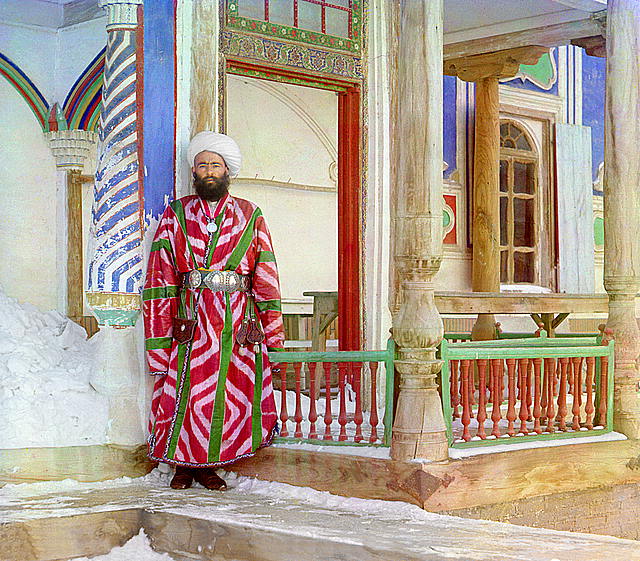
These photos of Muslims in Central Asia (then part of the Russian
Empire) are truly fascinating. These lands were the centre of Islamic
learning and scholarship in which the likes of Imam Bukhari and Imam
Tirmidhi lived. Between 1909 and 1912, photographer Sergei
Prokudin-Gorskii undertook a photographic survey of the Russian Empire
with the support of Tsar Nicholas II. He used a specialized camera to
capture three black and white images in fairly quick succession, using
red, green and blue filters, allowing them to later be recombined and
projected with filtered lanterns to show near true color images. When
these photographs were taken, neither the Russian Revolution nor World
War I had yet begun.
Take a step back in time and see what life was like for Muslims more
than a century ago with these photos made available by the Library of
Congress, which purchased the original glass plates back in 1948:
A boy sits in the court of Tillia-Kari mosque in Samarkand (present-day Uzbekistan).
Two prisoners are seen shackled together in chains.
A man and a woman from Dagestan pose together. The man can be seen carrying his sword.
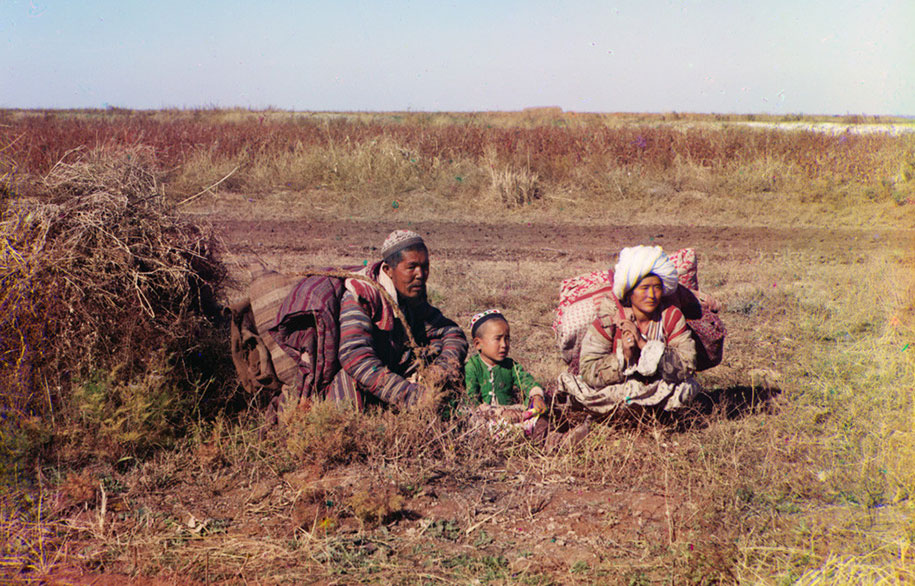
Nomadic Kirghiz on the Golodnaia Steppe (present-day Uzbekistan and Kazakhstan).
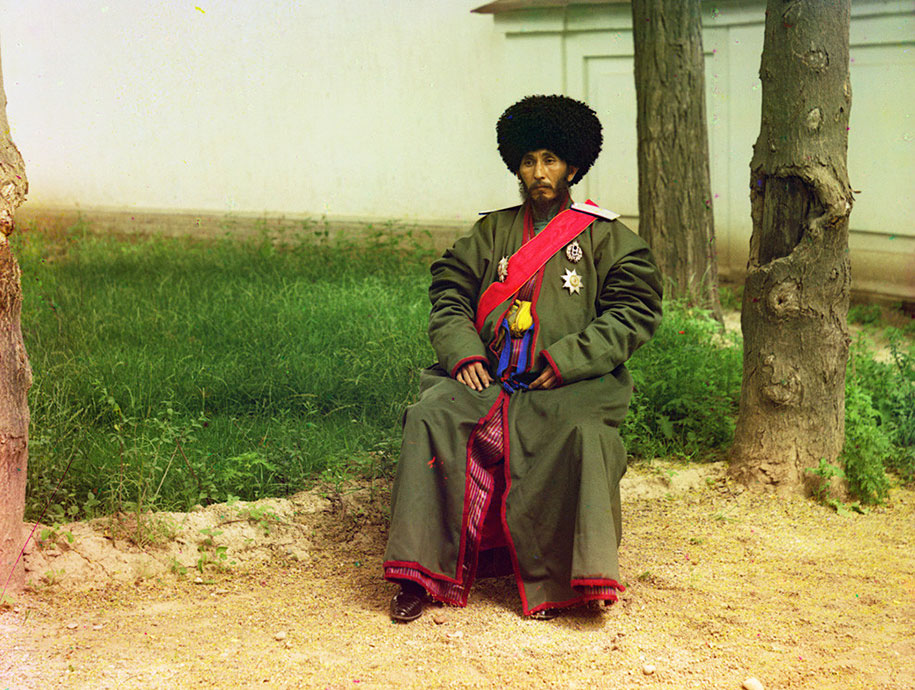
Isfandiyar Jurji Bahadur, Khan of the Russian protectorate of Khorezm
(Khiva, now a part of modern Uzbekistan) seated outdoors with full
uniform.
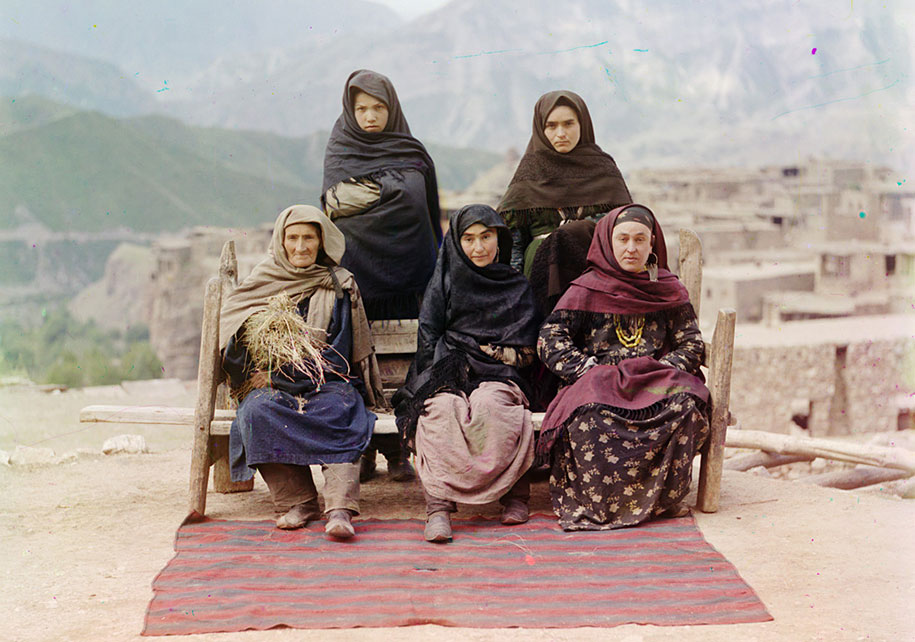
A group of women in traditional clothing from Dagestan.
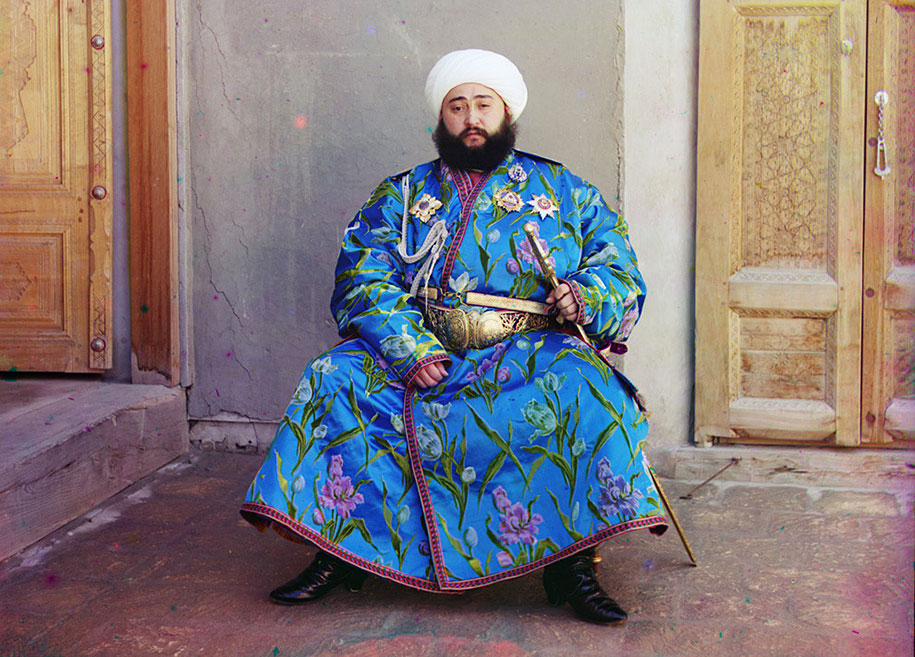
The Emir of Bukhara, Alim Khan (1880-1944), poses solemnly for his
portrait, taken in 1911 shortly after his accession. As ruler of an
autonomous city-state in Islamic Central Asia, the Emir presided over
the internal affairs of his emirate as absolute monarch, although since
the mid-1800s Bukhara had been a vassal state of the Russian Empire.
With the establishment of Soviet power in Bukhara in 1920, the Emir fled
to Afghanistan where he died in 1944.
A Sart woman in purdah in Samarkand, Uzbekistan. Until the Russian
revolution of 1917, “Sart” was the name for Uzbeks living in Kazakhstan.
A kebab house in Samarkand (present-day Uzbekistan).
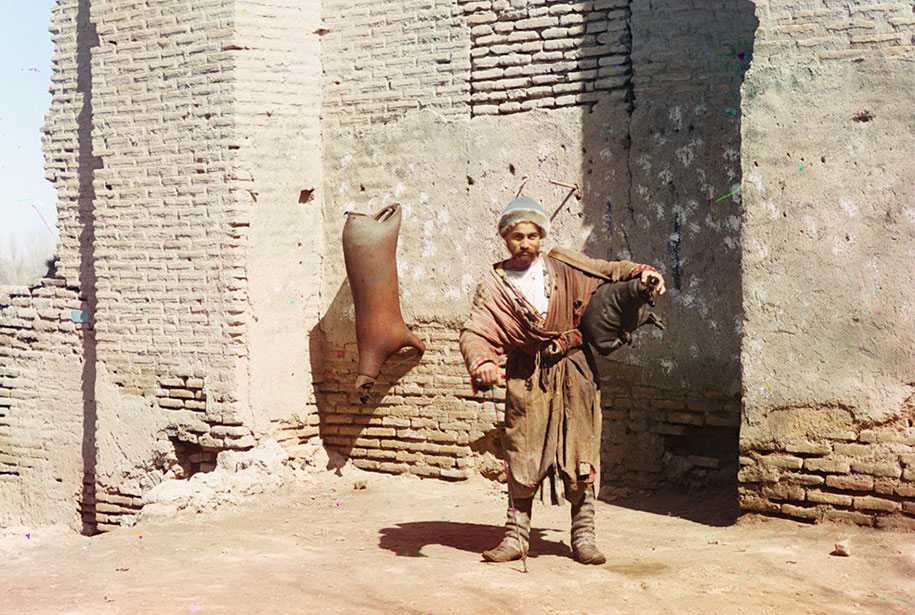
A water-carrier in Samarkand (present-day Uzbekistan).
An elderly man carrying birds in the snow.
A bureaucrat in Bukhara poses for the camera.
A cloth merchant in Samarkan (present-day Uzbekistan) sits in his stall.
A fruit seller sits in his market stall.
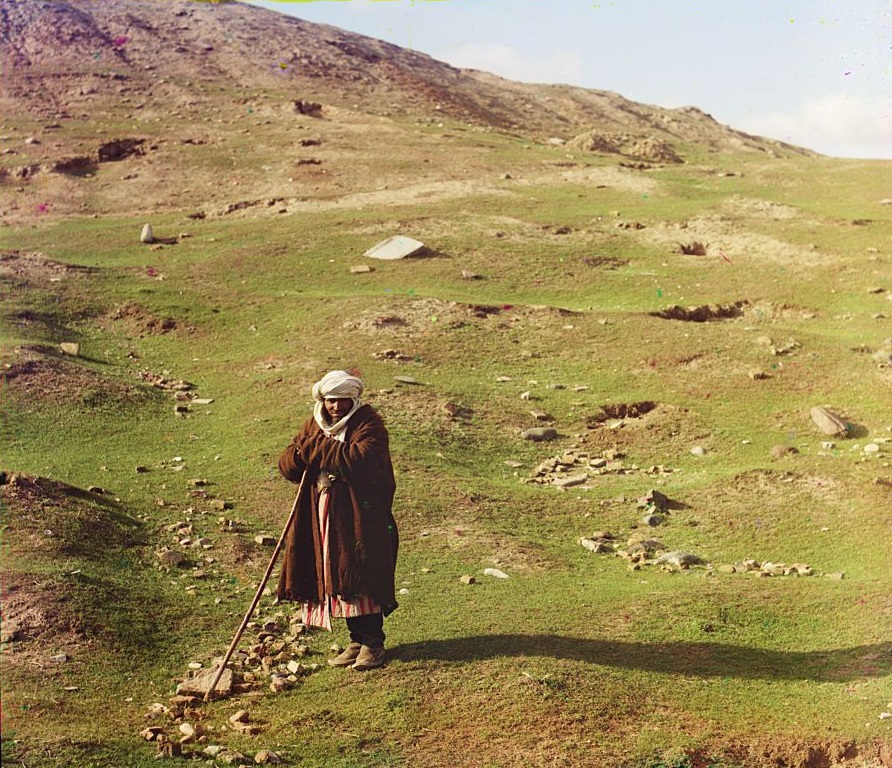
Shepherd pauses near a hillside, Samarkand (present-day Uzbekistan).
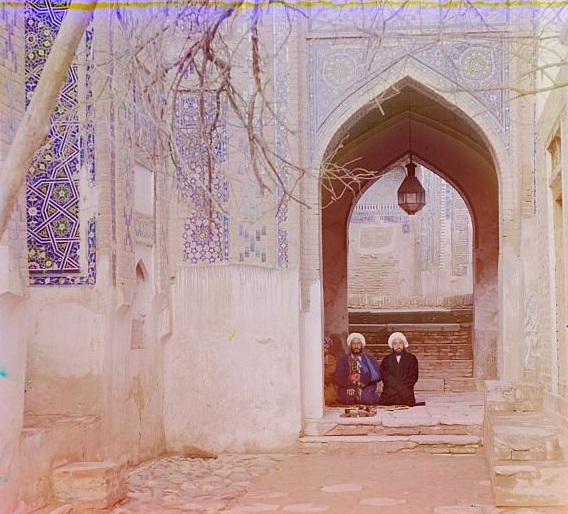
Two men sit in a mosque in Samarkand (present-day Uzbekistan).
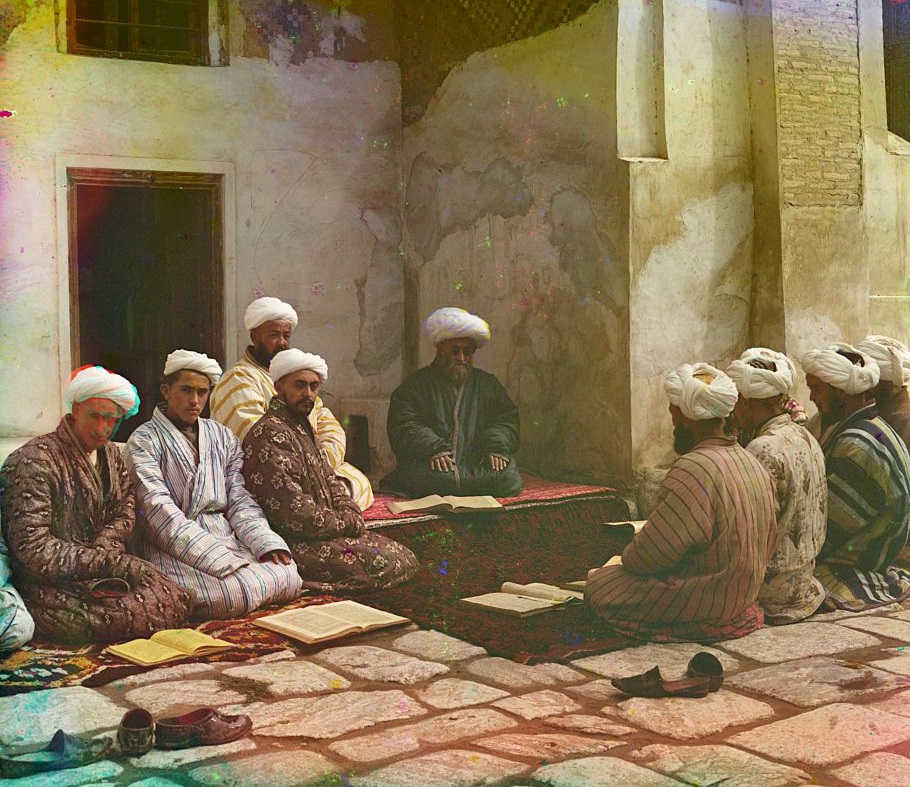
Students study with their teacher in a Madrassah (religious school) in Samarkand (present-day Uzbekistan).
Students sit outside their Madrassah (religious school) in Samarkand (present-day Uzbekistan).
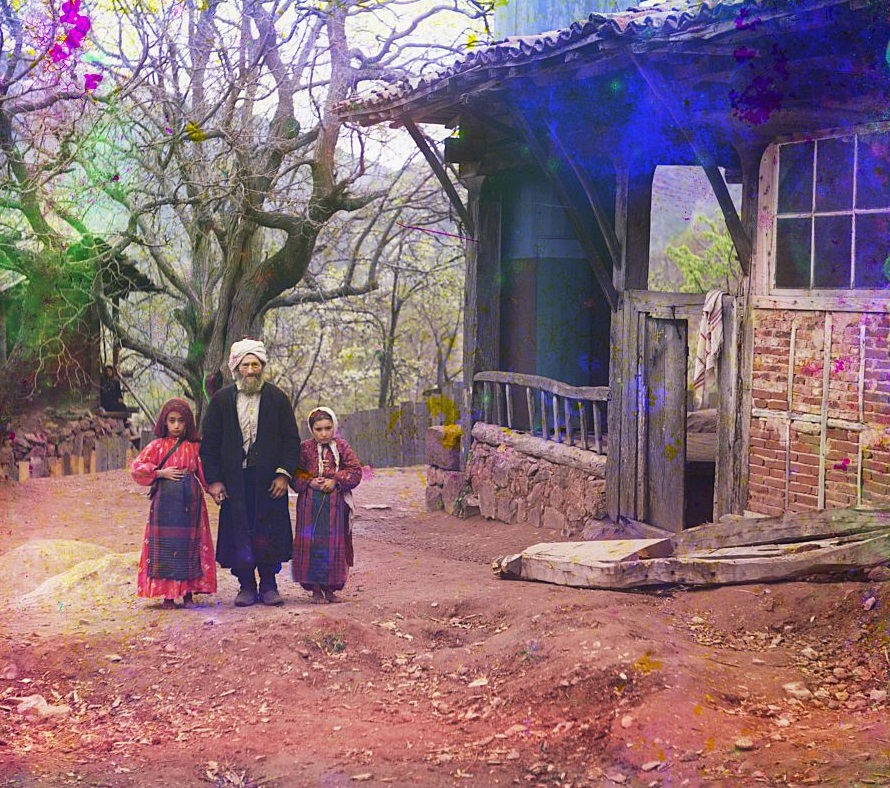
A religious teacher with his two daughters.
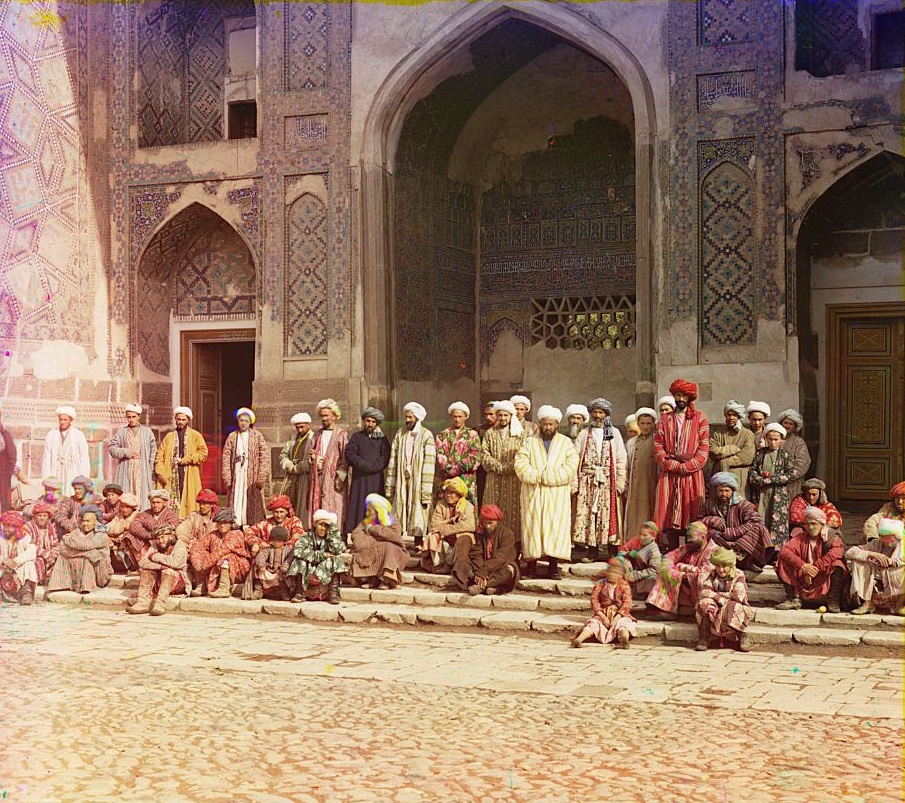
Worshipers are seen outside a Mosque in Samarkand (present-day Uzbekistan).
Like this article? Show your appreciation:
Che Gossett is an
independent scholar and researcher working on the legacy of Black queer
and prison abolitionist politics of Palestinian solidarity and a
scholar-in-residence at the Barnard Center for Research on Women.
They proudly admit that they are afflicted with what Derrida called
"achieve fever" are currently completing a writing project that
synthesizes the archival papers of Edward Said, James Baldwin, June
Jordan, and George L. Jackson. Their work as been featured in Captive Genders: Trans Embodiment and the Prison Industrial Complex and Queer Necropolitics. In this new Five Book Plan, they present their top 5 books on Malcolm X.
Che Gossett is an
independent scholar and researcher working on the legacy of Black queer
and prison abolitionist politics of Palestinian solidarity and a
scholar-in-residence at the Barnard Center for Research on Women.
They proudly admit that they are afflicted with what Derrida called
"achieve fever" are currently completing a writing project that
synthesizes the archival papers of Edward Said, James Baldwin, June
Jordan, and George L. Jackson. Their work as been featured in Captive Genders: Trans Embodiment and the Prison Industrial Complex and Queer Necropolitics. In this new Five Book Plan, they present their top 5 books on Malcolm X.
The
New Atheist movement has become a pro-white supremacy movement that is
anti-Muslim, anti-Arab bigotry dressed up with a thin veneer of fancy
sounding words
Cenk Uygur is the lead anchor of one of the most watched online news broadcasts - The Young Turks Network.
I’ve appeared on Uygur’s show twice. The purpose of that previous
sentence is not an exercise in passive-aggressive bragging, but rather
to state that I have met the man on two separate occasions.
As a journalist, I have appeared on many programmes - OK, that was bragging - because media
outlets not only need content, but also analysis of what today’s
headlines mean. They also need a wide variety of perspectives. Thus,
I’ve met a great number of radio, television and online hosts. In
related news, if I were forced to identify my one superpower, I would
claim that it is my ability to make an accurate assessment of an
individual’s humanity at the moment of face-to-face introduction.
At that moment where hands meet and pleasantries are exchanged, both
narcissists and sociopaths look beyond you and talk past you in a way
that makes you feel like you’re not even there. This is the polar
opposite experience I have had on both occasions with Uygur. Every
atomic particle projected from his being screams: “I care about you. I
care about people. Now let’s communicate.”
Why am I telling you all this about Uygur?
On last week’s show, Uygur asked whether anti-Muslim bigotry has become the new McCarthyism
- a metaphor to the 1950s anti-Communist “practice of making unfair
allegations, or using unfair investigative techniques, especially in
order to restrict dissent or political criticism”. During these years,
lives and careers were destroyed by even the mere suspicion one
associated with or knew a Communist. “You’re friends with a Communist -
you can’t be trusted,” became the refrain of “Red scare” accusers.
Uygur provided a number of examples of anti-Muslim McCarthyism in
practice. He pointed to those who accuse President Obama of being
“anti-Israel” because he “knows two Palestinian professors”. In other words: “Obama pals around with Muslims - ergo ipso facto - he can’t be trusted.” Uygur,
an avowed atheist of Turkish origin, mentioned how he is often accused
of being a “Muslim sympathiser”, “Muslim apologist”, or “terrorist
excuser”. Taunts that have equally followed me since my 2010 release of Koran Curious: A Guide for Infidels and Believers.
“Cenk, everyday you’re sticking up for the Muslims,” Uygur said,
referring to himself in the third person, parroting those who accuse him
of the aforementioned “liberal sympathies”.
“Yeah, I’m guilty. Guilty as fucking charged, man,” Uygur
rebutted. “I am not for Islam. I have received death threats for what I
have said about Islam. But yes, I stick up for Muslim-Americans. And if
you want to get them, you’re going to have to come through me.”
This is the declaration of a man who cares for all humans, no matter
their religious persuasion or tribal affiliation. This is the
declaration of a man who sees humans as more than the sum parts of their
personal relationship with a God.
Uygur especially singled out “the whole Sam Harris, Bill Maher wing”
of atheism aka New Atheism, aka anti-theism. “They are rabid, man.
Everyday they do it [attack Muslim-Americans and those who defend
Muslim-Americans] online. Everyday. They’re relentless.”
Uygur rightfully asserted that many of these New Atheists wrongly
contend they’re liberal, even though celebrity New Atheists support
profiling and “want [authorities] to go into their mosques,
universities, college groups, and if need be urge first [nuclear]
strikes against them [a reference to Harris’s book].” Uygur added: “If
you believe any of that, you are not remotely progressive. You are a
foaming at the mouth neoconservative… so stop pretending you’re
liberals. You’re not! You agree with the Dick Cheneys of the world.
That’s what you are.”
I forwarded Uygur’s clip to my 19-year-old son. My son’s formative
years were (ages seven to 18) spent with me in Indonesia, the world’s
most populous Muslim country. Most of his dearest friends are Muslim. He
was moved by Uygur’s passionate plea. “Dad, that clip has now gone
viral among my friends back home,” he told me.
As heartfelt and obviously unscripted as Uygur’s plea was, however,
he fell short in identifying what the New Atheist movement really is, or
rather, what it has really become. It’s become a pro-white supremacy
movement. New Atheism is anti-Muslim, anti-Arab bigotry dressed up with a
thin veneer of fancy sounding words.
A crude language
Individually, and on a personal level, however, New Atheists can be
good people. Collectively and unwittingly, however, they not only
espouse white supremacy but they also speak in a language that is every
bit as crude and racist as fascist, neo-Nazi, movements. Although a
little more discreetly.
While New Atheists don’t use the overt racial epithets of say the Ku Klux Klan in the US, or Pegida in Europe, they use dog whistle terms like “barbarians,”“backwards,” and “violent”.
Moreover, New Atheists enthusiastically, and often unintentionally,
promote western imperialism, and any individual who supports an
erroneous narrative (“clash of civilisations” is the theme of New
Atheism) that, by design, attempts to justify western intervention in
the Middle East, Africa, or Asia is, ergo ipso facto, a white
supremacist.
Case in point: Somali-born, anti-Muslim activist Ayaan Hirsi Ali is feted by the New Atheist movement. Her most staunch supporters include celebrity New Atheists Harris, Bill Maher and Richard Dawkins.
Last weekend, Hirsi Ali was the keynote speaker at the largest annual
gathering of atheists - the American Atheists convention, despite the
fact both her fictitious biography and anti-Muslim bigotry are well documented.
On Wednesday, Harris launched a tirade on Twitter against liberals
who have been vocal in their criticism of Hirsi Ali. “Seeing the attacks
on Ayaan this week has been like watching a time-lapse of the left’s
intellectual and moral decay. Ugly and indelible,” he tweeted. This is
the same guy who praised Europe’s fascists for being the only ones
saying “sensible” things about Muslims.
Consider this: Hirsi Ali called for a “military war” against Islam -“all Islam”; praised Netanyahu’s 2014 ethnic cleansing of Gaza, which left 2,200 Palestinians dead, including 800 women and children; expressed sympathy
for Norwegian mass murderer Anders Breivik; and lauded Abdel Fattah
al-Sisi, who is arguably Egypt’s most brutal military dictator ever, as a
“reformer”.
But Sam Harris, who once said we should profile all Muslims and anyone who conceivably looks like a Muslim and defends the aforementioned heinous remarks of Hirsi Ail, thinks that it’s the left who are in “moral decay”?
Wait, what?
Like their anti-theistic genocidal forefathers of the middle 20th
century, New Atheists dabble in the dark arts of scientific racism.
“The cult of science promises to eradicate or reform the tainted and
morally inferior populations of the human race,” warns Chris Hedges.
Today’s New Atheists proclaim science and reason will save humanity;
bring an end to all wars; and bring about a more perfect civilisation.
On the way to this imagined utopia, however, and again like their
genocidal, anti-theistic forefathers of yore, they champion those who
urge violence and discrimination.
Case in point: Bill Maher defended Netanyahu’s racism by suggesting America would attempt to block black people from the polls if America too were surrounded by “black nations”.
As for Hirsi Ali, no New Atheist alive in America today is unfamiliar
with her story. But it’s not the retelling of her story they seek. They
want to rehear again and again how “Islam is one of the world’s great
evils”, or “the mother lode of bad ideas”, or the greatest threat to
Western civilisation, a “nihilistic, cult of death” and so on. They want
to be made afraid of Islam in order to justify their hate of Muslims.
The empire’s narrative
“Women of colour like Ayaan are celebrated by the mainstream only
because they reinforce empire’s narrative about a backwards Muslim
world,” tweeted Rania Khalek, a journalist for Electronic Intifada.
Sam Charles Hamad is a journalist with great expertise on the Middle
East and US foreign policy. On the day Hirsi Ali spoke and received “a
standing ovation” at the American Atheist’s convention, Hamad posted on
Facebook:
“You’ll find that the vast majority of Ali’s fans are white males who
hate Muslims and, in her, have found a perfect little brown-skinned
conduit for their bigotry. I’m not a racist or prejudiced, they can say
as they spout racism and bigotry. I’m a big fan of Ayaan Hirsi Ali. The
fact that she’s a complete fraud making a shitload of cash at the
expense of these slobbering white bigots would be rather funny if she
also didn’t appeal to genuine fascists and demonise Muslims in such a
fascistic and potentially dangerous manner.”
On last week’s episode of my podcast Foreign Object, I asked journalist Max Blumenthal why our recent respectivecriticisms
of Hirsi Ali have generated so much blowback hate, particularly from
New Atheists and neoconservatives. “The narrative Hirsi Ali tells is …
very comforting to Americans. It tells them that they’re good. That
they’re inherently good. That they’re peaceful. That all these wars
they’ve been involved in have been forced upon them. That their hands
are clean. That they’re in a religious conflict with no political roots
that requires a nuanced discussion or historical context. That
colonialism never happened. That lies about WMDs never happened. That
all of these are just left-wing lies, and it is they who speak in a
clear, comforting language. [The reason we are hated] is we are
interrupting that narrative.”
I’m glad Uygur is courageous enough to interrupt “that narrative”
too. “If you want to say Islam is wrong, I’m a million percent with
you,” Uygur declared. “If you want to say we should treat this group of
people differently, you’re fucking wrong and I’ll fight you to the death
on it.”
If there’s a lesson to be gained from the US state of Indiana “walking back” of its anti-LGBT laws
last week due to widespread public outrage, it’s that hate can be
conquered if those who peddle it are marginalised to the edges. New
Atheists are the secular equivalent of the Christian Right. They too
must be overcome. A civil, pluralistic, secular society depends on it.
Several weeks ago, a video
surfaced on the internet, documenting outrageous animal abuse at a
‘halal’ slaughterhouse in North Yorkshire, England. A single viewing of
the video is enough to make the most compulsive meat-eater drop the
steak knife, and re-examine what ‘halal’ means to us.
For those of
us who have grown up watching animals bleating and thrashing their legs
as they are slaughtered in the front porches of our homes, the video
may be only a degree and-a-half above our threshold of tolerance. It
depicts workers angrily throwing and kicking sheep across the abattoir
floor, sometimes even cheering as they slit the animals’ throats (often
in multiple attempts).
In the United Kingdom, a country
where up to 88 per cent of the animals are 'stunned' before being
slaughtered, the uproar was ground-shaking. Also read: Halal food authority?
Practicing
Muslims around the world, especially in non-Islamic countries, take
great pains to ensure that the food they’re consuming is halal. I’ve met
conservative Muslim friends in Europe denying themselves ketchup, and
altogether avoiding restaurants where non-halal food is served, for fear
of it being prepared in the same cookware as pork.
Similar care
is taken by people of the Jewish faith. Such are the similarities
between the religious demands of each group that less discerning Muslims
in Western states have a rule of thumb that ‘kosher’ food is
permissible for them to eat, as ‘halal’ food is permissible for Jewish
people. Regrettably, when we say ‘halal’, we focus solely on the method of slaughter – the correct ritual of zibah by the Muslims, and schechita
by the Jews. The preoccupation with the ritual leaves little attention
to be paid to the environmental and ethical costs of our demands.
Moderate
Muslims generally agree that humane production is an integral part of
what makes meat ‘halal’. Theoretically, the animal must be killed as
swiftly and painlessly as possible, as long as the blood loss isn’t
arrested. Read on: Politicising the holy cow, alienating India's minorities
In contrast to that ideal, The Telegraphreported a sharp rise in animal slaughter without pre-stunning in the UK, allegedly due to stronger campaigning by Muslims for traditional slaughter practices.
Meanwhile, the Danish government put its foot down, and revoked the
religious exemption to the law requiring animals to be stunned before
slaughter. Fighting the dual charge of anti-Semitism and Islamophobia,
the minister for food and agriculture, Dan Jørgensen, unapologetically stated that “animal rights come before religion”.
Although
condemned by the conservatives as an attack on religious values, most
progressive Muslims seem to be in agreement with the Danish government. After
all, how does it reflect on one’s faith to stand before the court
demanding to be exempted from laws preventing animal cruelty, arguing
that one’s (interpretation of) religion mandates said cruelty?
This
is not to say that animal abuse is the fief of halal or kosher meat
industry. We have enough footage of animal abuse in regular
slaughterhouses to prove an epidemic of apathy for the process that
turns a non-human creature into a patty to grace those lonely
sesame-buns. Take a look: Seeking a niche in the halal market
As
I order a bowl of mutton curry at a restaurant, I may have a list of
concerns about its price, taste, calorie count, gluten content,
genetically-modified ingredients and whether the meat comes from an
animal slaughtered in a ritual consistent with my religious values; the
suffering of the animal whose remnant lies before me as my casual meal,
seldom appears on that list.
Clearly, we aren’t being picky enough
about what we eat. It may be time for a more comprehensive definition
of ‘permissible’ food, which as a matter of decency, should flatly
exclude the meat of animals that are not treated humanely.
Following the publication of his Atlantic cover story, “What ISIS Really Wants,” Graeme Wood has challenged critics who claim that he misrepresented Islamic belief, noting, “It’s
instructive to see how responses to my piece reckon with or ignore this
line: ‘Muslims can reject the Islamic State; nearly all do.’”
But Wood’s entire essay implies that such a rejection of ISIS by other
Muslims can only be hypocritical or naive, and that ISIS members and
supporters follow the texts of Islam as faithfully and seriously as
anyone.
The main expert in Wood’s article is Princeton
University professor Bernard Haykel, who “regards the claim that the
Islamic State has distorted the texts of Islam as preposterous,
sustainable only through willful ignorance. … In Haykel’s estimation,
the fighters of the Islamic State are authentic throwbacks to early
Islam and are faithfully reproducing its norms of war.”
Put another way: Not only are Muslims wrong that ISIS is distorting Islamic texts, but the very idea is preposterous. ISIS is faithfully following Islamic norms of war. All of this might lead a thoughtful reader to wonder what all the other Muslims are doing.
* * *
Wood quotes Haykel’s invocation of an axiom, common in
academic discourse, that there is no such thing as ‘Islam,’ rather,
“It’s what Muslims do, and how they interpret their texts.” Presumably
Wood does this in order to emphasize that he is not personally offering a
criterion to judge who is a good or bad Muslim. But he introduces just
such a criterion: namely, that a Muslim is evaluated according to his or
her interpretation of these texts. His article evaluates ISIS against
other Muslims on this basis.
“What’s striking about [ISIS] is not just the literalism, but
also the seriousness with which they read these texts,” Haykel said.
“There is an assiduous, obsessive seriousness that Muslims don’t
normally have.”
But who decides who takes the texts seriously? On what
grounds do non-Muslim journalists and academics tell Muslims that their
judgment that ISIS does not take a full and fair view of the Quran and
Sunnah (the example and teachings of the Prophet Muhammad) amounts to a
“cotton-candy” view of Islam, while these non-Muslims retain the right
to judge how “serious” ISIS is in its
If we take the “It’s what Muslims do, and how they
interpret their texts” axiom seriously, then there would be no grounds
to declare that a Muslim who believes in a pantheon of gods is
unfaithful to the teachings of Islam. After all, the Quran, speaking
with the Divine Voice, often uses the royal "We" when addressing Muslims.
Would this belief in multiple gods also be ‘Islam’? Would these
polytheistic Muslims have “just as much legitimacy as anyone else”
because they are drawing on the same texts as other Muslims?
Can we extend the axiom of “There is no X, there is
only what followers of X do and how they interpret their texts” beyond
Islam? If a scientist claims, “Eugenics is not a valid application of
the principles of science, and is unscientific,” should he expect to be
told that the eugenicists were “just as legitimate as anyone else”
because they are following the same body of texts? Were not the
eugenicists “serious” and “assiduous” in their science, at least in
their own eyes? Did they not speak the language of science, and base
themselves on Darwin?
ADVERTISEMENT
In
fact, no one acknowledges that all interpretations of their own system
of ultimate meaning are equally authentic or faithful, whether this
system is scientism, communism, post-modernism, or any other
metaphysical commitment including religion. It is arbitrary to present
the Islamic interpretative tradition as an unrestricted free-for-all
where nothing is assessed on objective rational or moral criteria, in
which every last impulse or assertion is equal to all other responses
and can never be subjected to judgment or ranking.
* * *
What other Muslims have been arguing from the start is that ISIS doesnot take the texts seriously.
The Quran is a single volume, roughly the length of
the New Testament. It is a complex and nuanced text that deals with
legal, moral, and metaphysical questions in a subtle and multifaceted
way. Then there are the hadīth, or records of sayings and doings
of the Prophet Muhammad, which run into dozens of volumes spanning
literally hundreds of thousands of texts, each on average a few
sentences long. Then there is the juridical and theological literature
about the Quran and the hadīth, which consists of thousands of works written throughout Islamic history.
Does ISIS cite “texts”? Yes, though its main method is to cite individual ḥadīth that support its positions. But remember: The ḥadīth
consist of hundreds of thousands of discrete items that range from
faithfully transmitted teachings to outright fabrications attributed to
the Prophet, and every gradation in between.
Over the centuries, jurists and theologians of every
stripe, Sunni and Shiite, have devised rational, systematic methods for
sifting through ḥadīth, which are often difficult to understand
or seem to say contrary things about the same questions. They have
ranked and classified these texts according to how reliable they are,
and have used them accordingly in law and theology. But ISIS does not do
this. Its members search for text snippets that support their argument,
claim that these fragments are reliable even if they are not, and
disregard all contrary evidence—not to mention Islam’s vast and varied
intellectual and legal tradition. Their so-called “prophetic
methodology” is nothing more than cherry-picking what they like and
ignoring what they do not.
Furthermore,
it is past time to dispense with the idea that organizations like ISIS
are “literalist” in their reading of texts. Do the members of ISIS
believe, literally, “Wheresoever you turn, there is the face of God?” Of
course not. Nor would they interpret literally, “God is the light of
the heavens and the earth,” or any number of other passages from the
Quran that the so-called “literalists” are compelled to either ignore or
read as some kind of metaphor or allegory. I’d like to see ISIS offer a
“literal” interpretation of the ḥadīth that says that when God
loves a person, He “becomes the ear with which he hears, the eye with
which he sees, the hand with which he grasps, and the foot with which he
walks.”
What distinguishes the interpretive approach of groups
like ISIS from others is not its literalism (Sufis are indeed the most
“literal” of all such interpreters of the Quran) but its narrowness and
rigidity; for the adherents of ISIS, the Quran means exactly one thing,
and other levels of meaning or alternate interpretations are ruled out a priori. This is not literalism. It is exclusivism.
Wood expands on his impression of the religious
seriousness of ISIS fighters by pointing out that they speak in coded
language, which in reality consists of “specific traditions and texts of
early Islam.” Speeches are “laced with theological and legal
discussion.” But there is a wide chasm between someone who “laces” his
conversations with religious imagery (very easy) and someone who has
actually studied and understood the difficulties and nuances of an
immense textual tradition (very hard). I personally know enough
Shakespeare to “lace” my conversations with quotations from Hamlet and
the sonnets. Does that make me a serious Shakespeare scholar? I can
“code” my language with the slings and arrows of outrageous fortune, but
is that proof of my assiduousness in relation to the Bard?
* * *
The first thing I teach my undergraduates is that the
English word “Islam” has two distinct but related meanings: the “Islam”
that corresponds to Christendom (the civilization) and the “Islam” that
corresponds to Christianity (the religion). The result is that the term
“Islamic” has two separate but related uses, as does “un-Islamic.”
In his article and elsewhere, Wood has challenged the
claim by Muslims that ISIS is un-Islamic by pointing out that ISIS
members are self-identified Muslims. But Muslims who say “ISIS is
un-Islamic” are not saying that ISIS fighters are not Muslims at all.
They are calling ISIS “un-Islamic” the way a politician might call
bigotry “un-American.” In fact, a prominent expert on ISIS has noted,
“I would be curious to know how many Muslims are willing to declare the
members of [ISIS] non-Muslim,” adding, “I bet you there are very, very
few people.” That expert is Bernard Haykel.
In other words, Haykel knows that few Muslims are prepared to describe ISIS as non-Muslim. And yet:
Muslims who call the Islamic State un-Islamic are typically …
“embarrassed and politically correct, with a cotton-candy view of their
own religion” that neglects “what their religion has historically and
legally required.”
Haykel recognizes that Muslims are not accusing ISIS
members of being non-Muslims. Instead, he seems to be objecting to the
Muslim claim that ISIS’s adherents are bad Muslims.
Throughout Wood’s article, this basic nuance between
“Islamic” as a normative label and “Islamic” as a factual or historical
label is absent, notably from such unqualified declarations as, “The
reality is that the Islamic State is Islamic. Very Islamic.” Can
such statements be interpreted as anything but a judgment of ISIS’s
fidelity to Islamic religion? If Wood was simply identifying the
tradition or civilization out of which ISIS has emerged, then what would
the word “very” mean? Wood also argues:
[S]imply denouncing the Islamic State as un-Islamic can be
counterproductive, especially if those who hear the message have read
the holy texts and seen the endorsement of many of the caliphate’s
practices written plainly within them.
Un-Islamic in which of the two senses? And again, on
what authority does Wood assert that such practices are “plainly” within
these texts? Determining what texts “plainly” say is not as easy as
spotting some words on a page. Islam’s interpretative tradition exists
because the differences between plain and hidden, elliptical and direct,
absolute and qualified, are not always obvious. The Quran speaks of
itself as a book containing passages that are muḥkam, or clear in meaning, and mutashābih,
or symbolic, allegorical, or ambiguous (even the significance of this
word is debated among Muslims). To make such a casual remark about what
is “plainly within” the Quran or other texts is to fail to take them or
the Islamic intellectual tradition seriously.
Wood further asserts with confidence, “The religion
preached by [ISIS’s] most ardent followers derives from coherent and
even learned interpretations of Islam.” It's just one more example of
how his essay, ostensibly a descriptive account of a group of Muslims
and its interpretations of texts, is in reality an account of the
fidelity of ISIS to Islamic teaching and a critique of the claim by
other Muslims that ISIS is wrong.
* * *
“The only principled ground that the Islamic State’s opponents
could take is to say that certain core texts and traditional teachings
of Islam are no longer valid,” Bernard Haykel says. That really would be
an act of apostasy.
In my experience, many Muslims are upset by articles
like this not because their feelings are hurt, but because such
arguments fill them with dread. They worry about what might happen to a
religious or ethnic group that policymakers or the public believe to be
intrinsically and uniquely dangerous.
When extremist groups like ISIS commit an atrocity or
make the news, politicians and commentators inevitably lament how
Muslims are not doing enough to “speak out” against the crimes carried
out in their name. But when Muslims do “speak out” and “condemn,” as
they always have,this seems to only reinforce the tendency to
blame Muslims collectively. And if one relies on Wood and Haykel, and
believes that the horrors perpetrated by ISIS are “plainly” in Islam’s
sacred texts and that it is “preposterous” to argue that these texts are
being distorted, then the notion that a faithful Muslim could be
critiquing ISIS in a moral and rational fashion is discarded. He can
only be a sympathizer, a hypocrite, or a dupe who is ignorant of the
requirements of his own faith. Wood’s essay leaves readers with a
gnawing fear that the majority of Muslims might wake up tomorrow and
start taking their texts “seriously.”
All of this puts Muslims in a double bind: If they
just go about their lives, they stand condemned by those who demand that
Muslims “speak out.” But if they do speak out, they can expect to be
told that short of declaring their sacred texts invalid, they are
fooling themselves or deceiving the rest of us. Muslims are presented
with a brutal logic in which the only way to truly disassociate from ISIS and escape suspicion is to renounce Islam altogether.
understanding of core Islamic
texts?
Palestinian fighters affiliated with the Gaza-based Hamas
Islamic resistance movement have engaged in the battle to force the ISIL
Takfiri terrorists from the besieged Yarmouk refugee camp in Syria, a
report says.
The development was announced Sunday by an
official in the support network for the Palestinian refugee camps in
Syria, Ayman Abu Hashem, who added that the fighters belonged to the
Aknaf Bayt al-Maqdes group and got engaged in the fighting despite a
decision by the Palestine Liberation Organization (PLO)-affiliated
factions to remain “neutral” in the battle over the war-ravaged refugee
camp, Ma’an News Agency reported.
According to Abu Hashem, the
group was once among the largest armed factions in the Yarmouk
camp before becoming weakened in recent weeks.
The report further
cited Farouk al-Rifai, a spokesman for the Palestinian civil society
network in Syria, as saying that the Hamas-linked fighters were joining a
group of civilians in the refugee camp in defending the territory.
He
further elaborated that there were 1,500 ISIL terrorists stationed near
Yarmouk while surrounded by Syrian army troops before they received
reinforcements and 700 of the militants managed to intrude into the
camp.
Both Abu Hashem and al-Rifai also stated that they had
documented three beheadings in the refugee camp, while three others were
executed by gunfire. They added that 70 more Palestinian refugees were
detained by the Takfiri terrorists for opposing the ISIL.
The development came as
Palestinian Liberation Organization (PLO) official Anwar Abdul Hadi
announced on Sunday that nearly 2,000 people were evacuated from the
refugee camp on Friday and Saturday.
According to Abdul Hadi,
Syrian government troops had assisted in the evacuation of the residents
of the camp as Palestinian forces continued the battle to hold off the
Takfiri ISIL elements, who have captured large sections of the refugee
camp since last Wednesday.
Yarmouk, once hosting tens of
thousands of Palestinian refugees as well as Syrians, has turned into a
ghost town as a result of the violent attacks by anti-government
militants over the past four years of turmoil in Syria.
How did a rogue band of radicals with such a destructive ideology
appear so suddenly and gain such influence in such a rapid timeframe?
The answer is an inconvenient truth -- but it is one we must accept if
we hope to stop ISIS. Some claim ISIS is merely an informed, practical,
or even educated manifestation of Islamic doctrine. This simplistic
answer, however, is as incorrect as it is dangerous.
If the goal is to defeat ISIS and stop it from spreading, it is
important we recognize what empirical data demonstrates -- that ISIS and
radical groups who sympathize with them are anything but Islamic. For
example, Al Jazeera journalist Mehdi Hasan cites a 2008 classified report by the MI5 on radicalization that:
Far
from being religious zealots, a large number of those involved in
terrorism do not practise their faith regularly. Many lack religious
literacy and could ... be regarded as religious novices." The MI5
analysts noted the disproportionate number of converts and the high
propensity for "drug-taking, drinking alcohol and visiting prostitutes,"
concluding, "A well-established religious identity actually protects against violent radicalisation.
Picking up right where this MI5 analysis left off, Professor Phyllis Chesler writes at length
on Islam and Muslims condemnation of pornography, and contrasts it to
the porn obsession of radicals like Osama bin Laden, Anwer al-Alwaki,
the 9/11 terrorists, and of course ISIS. The hypocrisy such radicals
exemplify is only confusing when we insist on calling ISIS Islamic. When
we recognize ISIS is un-Islamic, and for the virus it is, the picture
becomes much clearer. That is, whether it means stealing, abducting,
raping, prostituting, or killing, ISIS will simply do anything it has to
do to survive and spread.
Just as important, however, ISIS was never just a rogue band of militants that emerged out of thin air. As President Obama aptly stated recently,
"ISIL is direct outgrowth of al Qaeda in Iraq which grew out of our
invasion which is an example of unintended consequences which is why we
should generally aim before we shoot."
ISIS may have come to media headlines in the spring of 2014, but Western
injustices played a role long before. This virus was planted in the
1980s when the CIA created and trained radicals to fight our proxy wars. This virus was strengthened by studying books promoting radicalization and terrorism, paid for by U.S. tax dollars and printed at the University of Nebraska.
It was emboldened when the U.S. government funded and supported Saddam
Hussein's dictatorship. And it was let loose during the illegal Iraq War
in which the United States led a coalition of 36 nations to bomb and
destroy a nation and dictator they had previously built and empowered,
killing hundreds of thousands of civilians in the process.
Israeli
Prime Minister Benjamin Netanyahu's hawkish words from 2002 ring hollow
as he advocated for the illegal invasion, "If you take out Saddam's
Regime, I guarantee you, that it will have enormous positive
reverberations on the region." ISIS is tragically one such "enormous
positive reverberation."
Thus, to view ISIS in the vacuum of the
last year alone, while ignoring the decades of injustices heaped upon
Iraq by Western forces and the international community, is ignorant at
best. But the story doesn't stop here. Recognizing unjust Western
interventionism is only part of the equation to understanding and
defeating ISIS. We cannot exempt the role of some Muslim majority
governments.
The key to curing any virus is discovering its origin. ISIS's ultimate
origins stretch decades prior to Western interventionism, and helped
foster the soil for Western interventionism in the first place. The
Guardian's Kevin McDonald notes:
When
he made his speech in July at Mosul's Great Mosque declaring the
creation of an Islamic state with himself as its caliph, Abu Bakr
al-Baghdadi quoted at length from the Indian/Pakistani thinker Abul A'la
Maududi, the founder of the Jamaat-e-Islami party in 1941 and
originator of the contemporary term Islamic state.
Maududi advocated a violent and fascist worldview unprecedented in
Islamic history. In Maududi's warped view of how to spread Islam, no
person was spared and no ideology other than his view of Islam was
valid. He wrote in his book Jihad in Islam:
Islam
wishes to destroy all States and Governments anywhere on the face of the
earth which are opposed to the ideology and programme of Islam
regardless of the country or the Nation which rules it. The purpose of
Islam is to set up a State on the basis of its own ideology and
programme, regardless of which Nation assumes the role of the standard
bearer of Islam or the rule of which nation is undermined in the process
of the establishment of an ideological Islamic State.
While accounts vary, all agree that Maududi's education was at most a
high school diploma. He had no academic training on Islam, Arabic
scholarship, Qur'anic hermeneutics, hadith interpretation, or Islamic
history. Still, his warped ideology is whom the alleged scholar
al-Baghdadi "heavily cites" as the engine to drive ISIS. This is
significant because it exemplifies how dangerous it is to claim ISIS
represents some authentic or educated form of Islam. Those who promote
the myth that ISIS is spreading internationally due to its education of
Islam -- not its ignorance of Islam -- ignorantly empower ISIS while
disenfranchising and demonizing the world's billions of Muslims who
categorically condemn ISIS.
The role some Muslim majority governments have played in empowering ISIS
-- while backed by Western interventionism -- is that of implementing a
diluted version of Maududian ideology. In doing so, they have created
an atmosphere that in some significant ways mimics ISIS ideology. For
example, nations like Pakistan and Saudi Arabia promote death for
apostasy and death for blasphemy laws -- just like ISIS. Syria continues
to enforce violent and unjust enforcement on its citizens, planting the
seeds for future ISIS recruits. The 2011 Arab Spring has left millions
of Muslims in the MENA region languishing for just leadership but
finding only despotic regimes, ongoing economic inequalities, and social
injustices. Thus, ISIS isn't implementing a "pure version of Islam."
They're implementing a dystopian fantasy by Maududi, a man uneducated on
even the most basic tenets of Islam.
So this is the inconvenient truth we must recognize: ISIS exists due to
both unjust Western imperialism, and unjust Muslim majority governments.
To stop ISIS requires reversing this trend.
Mirza Masroor Ahmad, worldwide head of the Ahmadiyya Muslim Community and Khalifa of
the world's largest Islamic organization offered one possible solution
to accomplish this during an international peace symposium in Europe
last week:
...it would be far more effective for the
major powers to support the local governments, by taking them into
confidence and seeking to build a relationship of mutual trust. Through
close co-operation a joint-strategy should be formed to stop the spread
of extremism and its hate-filled ideology. This will surely prove more
effective than opposing the local governments by giving military
training and weapons to the local rebels. Such policies can only further
inflame the existing turmoil and tensions in those countries.
This approach requires the West and Muslim majority nations to look past
mere economic interests in oil and land and focus instead in
international law and justice. Therefore, the international community
can and must act quickly to recognize ISIS's origins as that of a
pseudo-political extremist organization -- not Islam. Muslim leaders
must restore compassion and justice to the center of morality and
religion and decry interpretations of scripture that breed violence,
hatred, or disdain . This tragedy of ISIS will be corrected and it is
the catharsis of Islam. This purge and purification will in time produce
a people who adopt a life of prayers, love and compassion. That is the
true destiny of Islam.
We will stop ISIS once Western leaders and Muslim leaders take personal
ownership based on absolute justice -- and that's the truth.
Achieves|featured|Hadith|Hell|Islam|Misconceptions About Islam|Qur'an|Reflections on the Qu'ran|Religion|Resources|Surah Summaries|Write For Us|Youtube|
In popular Muslim thought, the belief in 'As-Sirat' (a.k.a 'pul
sirat' / the bridge of the way, the bridge over hell) is often cited as
compulsory.
The 'As Sirat' is understood to be an extremely narrow (almost the width
of a hair follicle) and sharp bridge with hooks, clasps and thorny iron that
all souls (including the righteous / believers) will encounter on the
Day of Resurrection. It is understood to be surrounded by the raging fire of
Hell and one would need to cross this bridge in order to reach paradise or a
state of felicity.
The sinful will allegedly fall into its raging fire whilst those who
remained righteous, will make their way swiftly across this bridge at a pace
directly proportional to the good deeds that they would have earned during
their earthly abode. The first one to cross the bridge is understood to be
Prophet Muhammad.(pbuh)Muslim literature and websites are often found giving references and
details with regards to this belief.
From a Quran's perspective, there is absolutely no mention of
this bridge in the entire Quran.
This term and the fanciful narratives associated with it are only found
in
Islamic secondary sources
such as Ahadith.
Indeed, 'implicit' verses are often
cited such as those below, but as we will see in this article, such
interpretations are countered by explicit texts and context driven
themes from the Quran that deal with eschatology (death, judgement,
heaven and hell).
019.070
"And / moreover certainly, We know best those who
are most worthy of being burned therein.
019:071
"And there is not one of you (pronoun -
'kum') but will come / arrive / go
down (* warada / warid)(to it). This is, with thy Lord, a Decree which must be
accomplished."
It remains noteworthy; that any 'implicit'
verse of the Quran must be understood in light of explicit verses. A
belief or doctrine should arguably never be formed based on 'implicit' text alone, especially in the
presence of explicit verses or stronger contexts which would deny such a
belief.
No doubt, the Quran provides many narratives dealing with eschatology(death, judgement, heaven and hell).
For example, Surah Fajr (89) cites a succinct narrative of the righteous
when they are spoken to after their death and on the Day of Resurrection
(89:27). They are welcomed into a place of felicity, God's Garden (My
Garden / Paradise -'jannati'). Albeit the intention of the narrative
appears to remain succinct, one does find remarkable that there is no
mention of a bridge. However, a trial (accountability) of some sorts is
expounded in other Surahs such as Surah Araf (Chapter 7), where a detailed
portrayal of the Day of Judgement is given and the communication of both
dwellers of the garden and those of hell is shared. (7:38ff; particularly
7:44ff). However, once again, one finds no mention of a
'bridge' or the requirement of all God's
servants to cross over it with a view to reach paradise.
Furthermore, one would have also arguably expected some mention of this
bridge in Surah Waqia (Chapter 56) where comprehensive eschatological
details are expounded in the course of the entire Surah. Again, no
mention of a bridge is found. Surah Rahman also captures a vivid
portrayal of what will transpire on the Day of Judgement and once again,
there is no mention of any bridge, or any crossing of it for all
God's servants.
Moving on from context driven narratives dealing with eschatology where
one would expect mention of a bridge, what remains noteworthy, is the
explicit mention in verses 21:98-102 that righteous individuals would be
far removed from even so much as the slightest sound of hell,
let alone being drawn nigh to it in order to cross over it.
021.098-100 "Indeed, you and what you worship besides God, are
(but) fuel / firewood for Hell! To
it you will come / go down to it / arrive (* warid)"
021.101 "Indeed! those to whom kindness / good has gone
forth from Us, they will be far removed from it"
021.102-103
"They will not even hear the slightest sound / whisper (hasis)of it,
and they will abide in that which their souls desire forever. The
supreme terror will not grieve them, and the angels will welcome / greet
them, (saying): This is your Day which you were promised"
* Warid - from the root verb 'warada'
means to come / to be present / to arrive at something (e.g. a man or
camel arriving at water to drink etc.).
Classical lexicologists make it clear that 'arrival' does not necessarily
imply that one will 'enter'. It simply means to arrive at something.
Thus, if the righteous are not to even 'arrive' (warid) at hell
(21:101) being kept far from it, then the whole popular belief of the bridge
(over hell) becomes very questionable. Furthermore, if believers are not
even to hear the slightest sound of Hell (and hence be kept away
from it), the belief of all souls passing over a bridge surrounded by
hell becomes wholly unwarranted from a Quran’s perspective. This
argument is further strengthened, when one considers the narratives in
verses 25:11-12 where is it made clear that the roar of hell would be so
audible, that it will even be heard from a distance.
025:011
"Nay, they deny the Hour (the Day of
Resurrection), and for those who deny the Hour, We have prepared for
those a blazing Fire (i.e. Hell)."
025:012
"When it (Hell) sees them from a far place, they will hear its raging
and its roaring."
025:013
"And when they shall be thrown into a narrow place
thereof, bound in chains, they will exclaim therein for destruction."
It is thus clear that in order for the roar of hell to remain inaudible
to the righteous, they will never be brought nigh to it, which is
also supported by the explicit text of verse 21:101.
We thus find in the Quran, explicit and context driven verses dealing
with eschatology, that completely negates the common beliefs of Muslims
pertaining to 'The Bridge', which is predominantly sourced from
Islamic secondary sources
such as Ahadith.
IMPLICIT DEDUCTION
As briefly mentioned in the initial paragraphs of this article, the
Quranic evidence cited for such a common belief in Muslim thought, attempts
to seek support from verses 19:70-71:
019.070
"And / moreover certainly, We know best those who
are most worthy of being burned therein.
019:071
"And there is not one of you (pronoun -
'kum') but will come / arrive / go
down (* warada / warid)(to it). This is, with thy Lord, a Decree which must be
accomplished."
The first point to note is that there is no mention of a bridge in these
verses. Secondly, if the context of the verses is studied, the pronoun
'you' (kum)(those that will go down / arrive at it) seems to be
clearly linked to those who were most stubborn and rebellious from
all sects mentioned in the previous verse, 19:69. This is made clear when
the verses are read in context.
019.069
"Then / moreover surely We will drag out
from every sect all those who were worst in obstinate rebellion
against the most gracious (God) (Most Powerful)."
019.070
"And / moreover certainly, We know best those who
are most worthy of being burned therein.
019:071
"And there is not one of you (pronoun -
'kum') but will come / arrive / go
down (* warada / warid)(to it). This is, with thy Lord, a Decree which must be
accomplished."
Therefore, the pronoun (you) arguably references those wicked
leaders and followers in sin, who refused to alter their ways and remained
obstinately rebellious against God (19:69). This is further supported by
other verses which make it clear that it is the sinners that will be led
into hell.
011.098
"He will go before his people on the Day of
Judgement, and lead them (warada - mawrud)
into the Fire (as cattle are led to water). And wretched / woeful is the
place to which they are led!"
One notes that the same root verb 'warada'(to come, go
down, arrive, one which is led down to) that is used in verses 11:98 and
21:100, is also used in verse 19:71, all dealing with the guilty.
Thus the target audience consistently remains the evil-doers, and there
is no indication that every soul will be driven to hell, will pass by
it via a bridge, or will be brought nigh to it.
CITING THE EXCEPTION - THE QURAN'S USE OF 'THUMMA'
Some will note the exception in verse 19:72 and raise the question as to
where the righteous will be saved from, if not hell?
A common translation is noted:
019.072 "But (Thumma) We shall save those who guarded
against evil, and We shall leave the wrong-doers therein, (humbled) to
their knees."
The Arabic phrase 'thumma' often translated as 'and', but' or
'then' does not always imply a sequence. From a Quran's perspective, this
phrase is also understood to signify 'parallelism' or two events
occurring together / simultaneously / concurrently and not
necessarily in sequence (or one after the other).
For example in Surah 41:11, we note the phrase "thumma 'istawa"
signifying God's instructions to the heavens when it was still smoke, to
form. This was not an action carried out in sequence, or after the creation
of mountains on the earth (41:10), but rather, it was an action in tandem or
simultaneously with the creation of the Earth. Thus 'thumma' is
better rendered in such contexts as 'moreover' or signifying a
simultaneous action rather than one in sequence. This phrase is also
used to signify repetitive stress as can be seen in Surah 102.
Therefore, verse 19:72 is better understood as a simultaneous action
where whilst the guilty will be left in the pits of Hell, the righteous will
be saved from such a trial which is also supported by verse 21:101.
019:072 "Moreover (thumma) we will deliver those who feared / guarded against
evil and We will leave the guilty / wrong-doers therein bent on knees"
021.101 "Indeed! those to whom kindness / good has gone
forth from Us, they will be far removed from it"
FINAL THOUGHTS
The belief that all souls will be brought near a narrow bridge called the
'As-Sirat' on the Day of Judgement finds no explicit support in the
Quran.
From a Quranic perspective, one notes explicit and context driven verses
dealing with eschatology, that appear to completely negate this common belief
which is predominantly sourced from
Islamic secondary sources
such as Ahadith. As noted, implicit lean on verses such as 19:70-72 to support
such a mainstay belief appears to be wholly unwarranted.







.jpg)